School cafeteria: How can we make service run more smoothly?
Noémie Daniel
Updated on:
09 April 2026
Share this article
At the school level, even a few minutes of delay in the cafeteria are enough to throw the lunch break into disarray. Long lines, slower service, and stressed staff: even the slightest hiccup affects both students and staff.
To streamline service in the school cafeteria, traffic flow, food distribution, and crowd management must work together to create a simpler and more efficient experience.
Why is the smooth operation of school cafeterias such a major issue?
Before implementing the right tools, you need to identify the factors that are actually slowing down the process.
The practical consequences of a disorganized service
A confusing layout immediately increases wait times in the school cafeteria. Students have less time to eat lunch, the last few rounds become rushed, and the overall atmosphere becomes tense.
For the teams, this means more urgent restocking, more requests, and increased pressure during peak periods.
The 3 bottlenecks that are slowing down your service
The bottlenecks are concentrated in three areas: the entrance to the cafeteria, meal selection, and payment.
The simultaneous arrival of several classes creates an initial bottleneck, then hesitation at the entrance slows down the line, and finally, a lengthy checkout process blocks the exit. Mapping these areas helps improve the management of student flow.
How long should an optimal cafeteria service last?
The real indicator isn’t the length of the time slot, but the actual time allotted for the meal. In practice, aiming for at least 20 minutes of seated time per student is a solid starting point.
What digital solutions can help speed up the flow in the cafeteria?
When properly integrated, digital technology reduces wait times, ensures consistent volume, and provides teams with greater visibility.
Meal pre-orders: Plan ahead to reduce congestion
Pre-ordering streamlines service from the very beginning. By knowing the volume of orders before the rush, the kitchen can adjust its production, and students move through the self-service line more quickly.
It also improves the accuracy of forecasts and helps prevent both stockouts and overproduction.
The ordering kiosk in the school cafeteria significantly reduces wait times. Students can quickly view the menu, confirm their selection, and move through the line faster.
Within the Innovorder ecosystem, this component integrates seamlessly into production and workflow monitoring.
“Innovorder is one of the few providers to offer an integrated suite.” Julien Perret, Founder of BCHEF
Fast payment collection: reduce payment processing time by 60%
Payment remains one of the last remaining bottlenecks. Badges, QR codes, or automatic validation via cafeteria management software eliminate this bottleneck almost instantly.
The line is moving faster, and the staff are refocusing on customer service.
How can you optimize your operational organization without making a major investment?
Technology isn't everything. A better understanding of the space and more careful planning are often enough to eliminate much of the stress.
Rethinking the layout of circulation areas
A layout with too many intersections between the entrance, the distribution area, and the room naturally causes delays.
Conversely, a clear direction of traffic immediately improves the flow of traffic.
Optimize table turnover and seating management
A smoother table turnover allows for more guests to be served during the same time slot without changing the infrastructure.
Simply directing students to available spaces and organizing the cleanup process more efficiently is often enough to improve the pace.
Rearrange staff to maximize efficiency
Placing staff in critical areas—from the reception desk to restocking—immediately improves the flow.
This dynamic distribution reduces traffic jams and eases peak traffic volumes.
Distribution models that speed up service
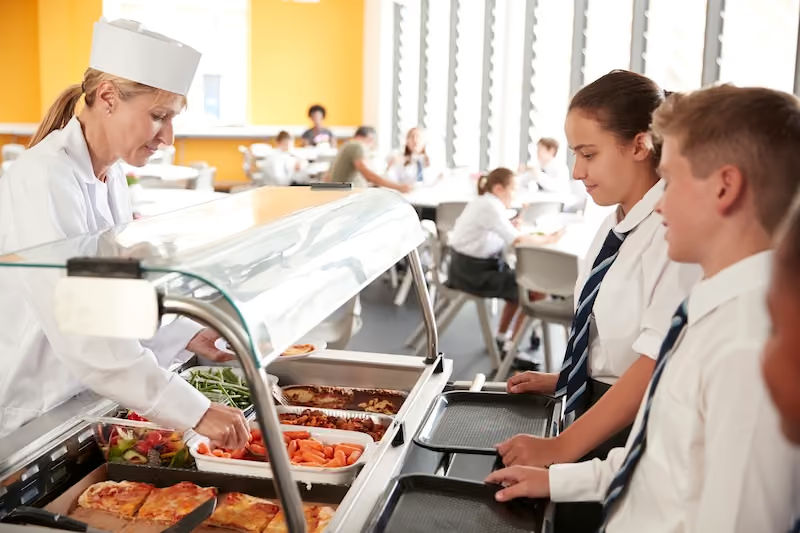
Double lines, islands, or segmented distribution help to better distribute traffic flows and prevent congestion at a single point.
These formats are particularly well-suited for high-density middle and high schools.
How can you measure and continuously improve the efficiency of your cafeteria?
The 5 Key Performance Indicators to Monitor
Average wait time, throughput, number of meals served per minute, dining room occupancy rate, and table turnover time provide a very reliable basis.
These KPIs enable precise management of the optimization of a foodservice operation.
Implement a continuous improvement process
By monitoring peaks, testing a new approach, and then measuring its impact, you can make progress without a significant investment.
With the Innovorder ecosystem, this adjustment process becomes simpler thanks to centralized data.
Reducing food waste through improved workflow
Improved cash flow enhances volume forecasting and minimizes production errors.
Students have more time to eat, which automatically reduces food waste.
What is the budget and ROI for digitizing a cafeteria?
The return on investment is quickly apparent: more customers served during the same time slot, less stress for staff, reduced waste, and higher satisfaction.
The guidelines issued by the Ministry of Education on school meals provide a useful complement to this discussion.
Smooth operations in school meal services depend on a balance between on-site organization, workflow, management, and digitalization.
By integrating payment terminals, payment processing, transaction data, and production tools into a single ecosystem, institutions can streamline services over the long term, reduce wait times, and enhance both the student experience and staff comfort.
"With 20 years' experience working for some of the world's largest foodservice groups, I'm helping the sector with its digital transformation through innovative digital solutions."
"With solid experience in developing key accounts, I'm supporting the digital transformation of the foodservice sector by proposing innovative digital solutions to optimize operations."