Effective Order Processing in the UK: Strategies and an Example from the CROUS
Noémie Daniel
Updated on:
06 April 2026
Share this article
In a university cafeteria, everything comes down to a matter of minutes. Between 11:45 a.m. and 1:30 p.m., foot traffic surges, lines grow longer, and the pressure mounts in both the kitchen and the dining hall. If you manage a university cafeteria, you know this better than anyone: order-taking plays a central role in handling high volumes without compromising the student experience.
In practice, it is often simple, well-integrated solutions that quickly relieve the pressure on the department.
Why optimize the ordering process at a university cafeteria?
The Challenges Facing CROUs in the Face of Student Mobility
In total, 2.9 million students attend CROUS institutions each year.The challenge is simple (on paper): to serve as many students as possible in the shortest amount of time. In reality, it’s a bit more complicated than that.
Peak times are very concentrated, and customer behavior can sometimes be unpredictable: groups arriving at once, indecision when choosing from the menu, last-minute changes, and so on. Budget constraints that limit flexibility must also be taken into account.
Without an optimized order-taking system, you’re at the mercy of the flow rather than managing it. One of the most telling metrics is the rate of customers abandoning their orders while waiting in line.
The Operational Impact of Queues on Profitability
A long line doesn't just hurt your cafeteria's reputation. It also has a direct impact on your performance.
In practice, this is reflected in:
Lost sales when students drop out,
Increased pressure on teams,
Service quality that declines during peak hours.
A cafeteria that falls behind on service can quickly lose dozens of meals. On a regional student services office (CROUs) scale, these losses eventually add up to a significant amount.
Regulatory requirements and the modernization of public services
University dining halls must meet specific requirements: accessibility, affordable pricing, and consistent service. To achieve this effectively, the modernization of these services is increasingly relying on digital solutions.
Going paperless for payments, making menus clearer and more accessible, and better managing customer flow—all these measures will help you comply with these requirements and simplify your day-to-day operations.
Optimizing the order-taking process is therefore fully in line with this approach: by streamlining the service and making it more accessible to everyone, you can balance regulatory requirements, operational efficiency, and an enhanced student experience.
What solutions are available to streamline the ordering process at university dining halls?
Online Ordering and Click & Collect: Save Time Up Front
Allowing students to place orders before they arrive is a game-changer—for them and for you.
For example, a student can select their meal late in the morning using their phone, choose a pickup time slot, and then pick up their meal without having to wait in the regular line. This simple adjustment to the process helps even out traffic and reduce congestion during peak hours.
The benefits are immediate:
Fewer people at the checkout at the same time;
A more even distribution of traffic across the department;
A smoother experience for students.
Standalone control terminals: easing physical congestion
Order kiosks make it possible to increase the number of order-taking points without requiring additional staff.
In a cafeteria, this results in shorter lines at the register and a more even distribution of students throughout the space. Everyone moves at their own pace, which helps prevent bottlenecks caused by people hesitating when placing their orders.
In practice, staff members have observed that some students naturally head to the payment terminals, which eases the burden on traditional checkout lines.
Kitchen Display Systems (KDS): Synchronizing Preparation and Service
You’ve probably already noticed this disconnect between order intake and the kitchen’s actual ability to keep up.
The KDS system helps restore consistency across the entire operation. Orders are displayed directly on screens in the kitchen, along with:
A clear order of priority,
A real-time view of current orders,
Better coordination between departments.
As Faizal Jogiat, founder of Chicken Village, points out, “Production screens are essential for handling a high volume of orders.” This is particularly true in university dining halls, where peak traffic demands flawless organization.
On the ground, the results are immediate: fewer mistakes, less stress, and smoother service—even during peak hours.
Centralized back office: real-time management
Having digital tools is just the first step. Being able to use them effectively is another matter entirely.
A centralized back office allows you to:
Track volumes in real time,
Identify peak traffic times,
Quickly adjust the menus or quantities,
Manage multiple restaurants from a single interface.
This tool is particularly useful for the CROUS, which often manages multiple sites with varying circumstances. Centralizing data makes it possibleto standardize practices while maintaining a detailed understanding of each institution, thereby enabling the adoption of the most appropriate strategies.
Payment and collection: Avoid creating a new point of friction
Quick order processing is great, but your efforts can be undermined if the payment process isn't just as efficient.
In a cafeteria, smooth operations also depend on:
Contactless payment;
Student ID cards or digital solutions;
Instant synchronization between order placement and payment processing.
A well-designed checkout process should allow students toproceed from order placement to payment without any interruptions. Otherwise, you’re just shifting the problem instead of solving it.
Menu Management and Specific Requirements for the University Dining Hall
University dining halls face unique challenges that can only be addressed with specialized tools.
It’s not just about displaying a menu, but about managing:
An effective solution must be able to automate these rules without complicating the teams’ work. This is often what sets a “generic” tool apart from one that is truly tailored to the context of the Crous.
Case Study: How the Crous de Rennes-Bretagne Digitized Its Order Processing
Background and Initial Issues
It is worth noting that institutional catering in France represents a massive volume: 3.6 billion meals served in 2024 across more than 75,000 locations, including 36,000 in educational institutions. Even if each cafeteria serves only a fraction of these meals, these figures illustrate the scale of the traffic to be managed every day.
Like many similar organizations, the Crous de Rennes-Bretagne was facing:
Long lines;
Excessively long service times;
Constant pressure on the teams.
The result? An experience that can be frustrating for students and difficult for staff to manage on a day-to-day basis.
The solution implemented: online ordering with in-store pickup
The system is based on a white-label online ordering platform called Crous & Go, which is integrated with IZLY and the Crous’ digital tools. Students place their orders from their phones, select a pickup time slot, pay through their IZLY account, and pick up their meals without waiting in line.
In the kitchen, every order is displayed in real time on production screens. The teams verify each step of the preparation process, and the customer is notified when their meal is ready. A back-office system centralizes the management of menus, inventory, and pickup locations, supplemented by an analytics tool for performance monitoring.
The system was deployed in partnership with Innovorder.
Results
The initial results are clear: shorter wait times at the point of sale, an increase in online orders, and real operational time savings for the kitchen staff.
How to Choose and Manage an Order-Taking System in the UK?
Criteria for Selecting a Digital Solution
Before making a purchase, take the time to assess your needs. A suitable solution should:
Be able to handle large volumes without slowing down;
Remain easy to use for staff and students;
Integrates seamlessly into your existing environment;
Enable centralized management if you manage multiple sites.
Another key point: its ability to adapt over time. Your needs will change, so your tool needs to be able to keep up.
Key performance indicators to monitor
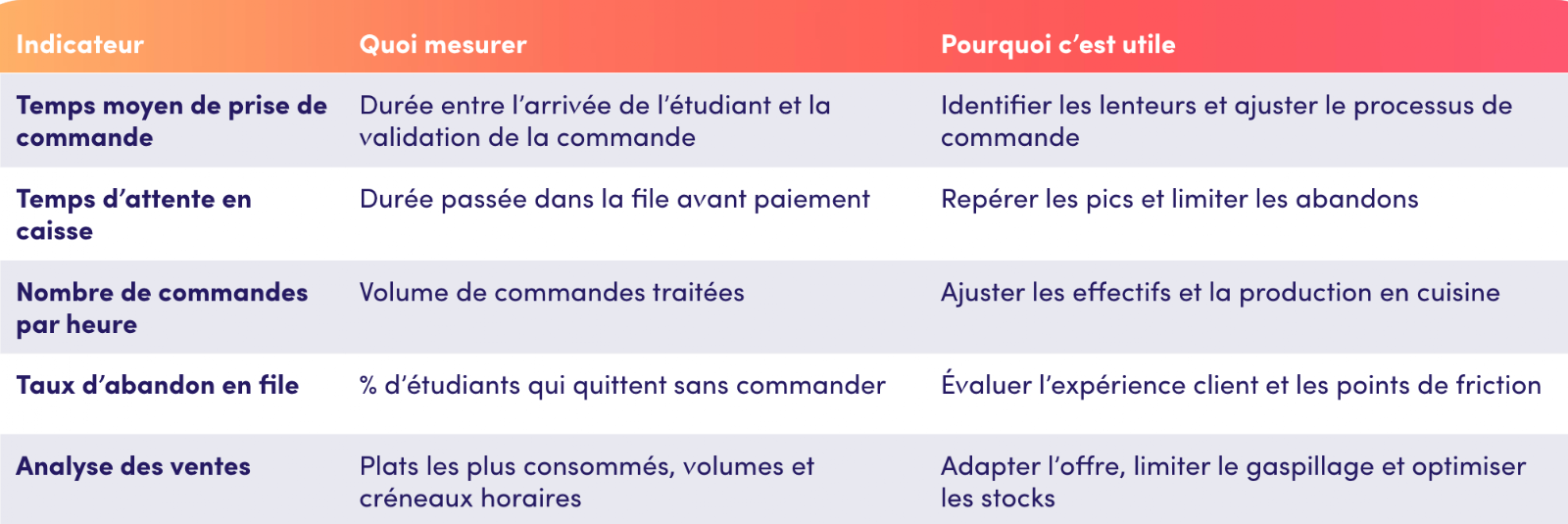
To effectively manage your program, focus on a few key metrics:
Supporting teams and students through change
The success of the project does not depend solely on technology.
Training teams, explaining the new learning paths to students, and providing support during the first few weeks of use are essential steps. The smoother the transition, the faster the adoption.
In a campus cafeteria, every student who is served quickly and without stress represents a small daily victory. Building on these successes transforms the dining experience: lines get shorter, staff work more calmly, and students leave satisfied.
Optimizing order processing isn’t just about implementing digital tools; it’s about reorganizing workflows, anticipating peaks, and coordinating teams so that every operation runs smoothly and efficiently.
How can you make the ordering process faster and smoother in your campus dining hall? The experts at Innovorder will work with you to analyze your workflow and implement practical solutions tailored to your campus dining hall.
"With 20 years' experience working for some of the world's largest foodservice groups, I'm helping the sector with its digital transformation through innovative digital solutions."
"With solid experience in developing key accounts, I'm supporting the digital transformation of the foodservice sector by proposing innovative digital solutions to optimize operations."