Everything you need to know about fast food franchise agreements
Noémie Daniel
Updated on:
02 January 2026
Share this article
Franchising is often seen as a shortcut to success in the fast food industry. A well-known brand, a proven concept, and established methods are all reassuring factors when starting or expanding a business. This attractive model is based on a well-defined framework. And that framework is the franchise agreement, which structures your daily life as a restaurant owner.
Before signing, it is best to understand what it really entails, beyond the sales pitch. Here is a practical breakdown to help you see things more clearly.
Fast food franchising: is it the right model for you?
Fast food is particularly well suited to the franchise model. High volumes, standardized recipes, fast service: everything is based on precise, reproducible processes.
For a restaurant owner, franchising allows them to:
Rely on a concept that has already been validated by the market,
Benefit from immediate recognition,
Save time on organization and structuring.
This model also has its limitations. As a franchisee, you are operating a concept that is not your own, with rules to follow, so you are never completely independent.
Before signing: the right questions to ask yourself when you're a restaurant owner
Before even getting into the details of the franchise agreement, it is essential to ask yourself the right questions.
Are you ready to:
Apply strict processes, even if they don't always match your habits?
Use tools imposed by the network for order taking, payment collection, or management?
Report regularly on your performance?
Next comes the analysis of the Pre-contractual Information Document (DIP). In France, this step is governed by Article L. 330-3 of the Commercial Code, derived from the Doubin Law, which requires the franchisor to provide this document at least 20 days before the contract is signed or any payment is made, so that the future franchisee can make an informed decision.
In concrete terms, the DIP helps you assess the robustness of the network, the investments to be anticipated, and the broad outlines of your future contract.
To consolidate your knowledge of the network, take the time to talk to active franchisees. They will tell you whether the support is genuine, whether the tools are suited to the field, and whether the model delivers on its promises over time.
Franchise agreement: understanding what you are really committing to
The franchise agreement formalizes the balance between what the network provides you and what it expects from you as a franchisee.
What the franchisor brings you on a daily basis
Beyond the brand, the franchisor generally undertakes to:
Transmit structured know-how,
Train the franchisee and their teams,
Supporting the opening and development of the point of sale,
Provide tools to organize the service and manage the activity.
In fast food, this side dish is crucial. It has a real impact in terms of kitchen efficiency, speed at the counter, and the ability to handle peak times without disrupting the team.
What the contract requires of you as a franchisee
In return, the contract imposes a specific framework:
Respect for the brand concept and identity,
Application of recipes and standards,
Use of listed suppliers,
Adoption of network tools.
In practice, this means less freedom, but also fewer decisions to make on your own. For many restaurant owners, this framework saves time and provides peace of mind, provided they accept it from the outset.
Franchise and profitability: how the contract changes your figures
The main financial and operational impacts of the franchise agreement
The question of profitability quickly comes to the forefront when it comes to franchising. And that's normal: this model and the contract that governs it have a direct impact on your costs, margins, and organization.
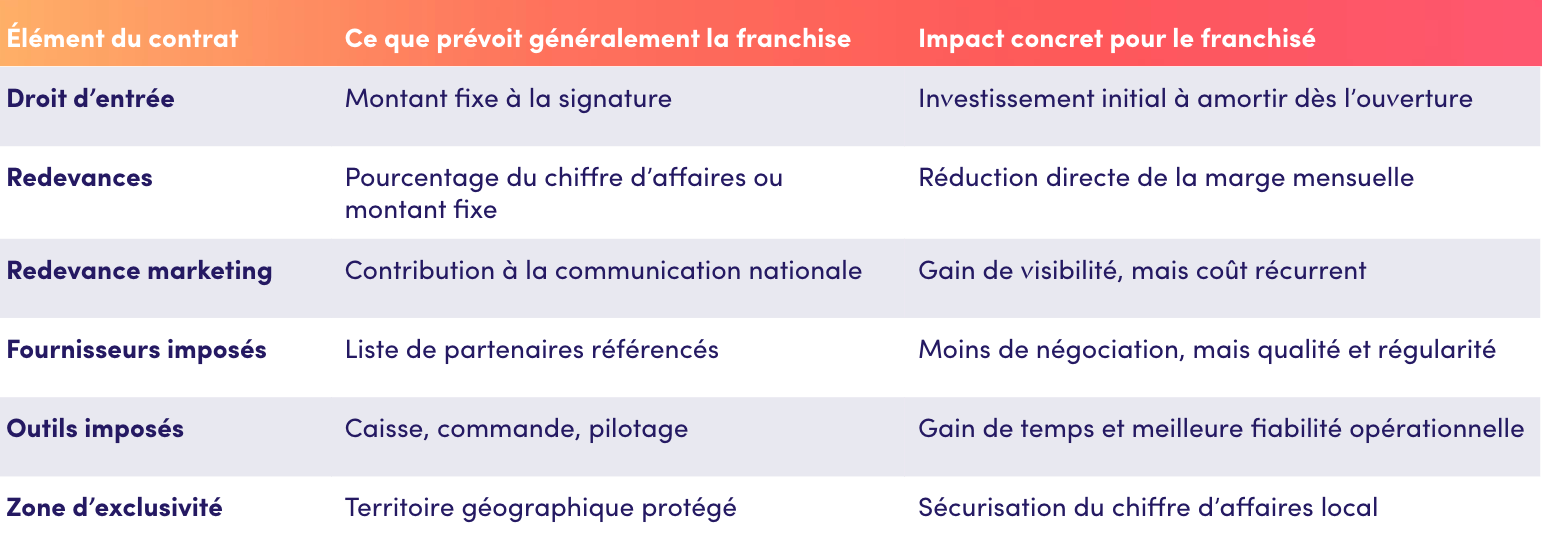
To clarify matters, here are the main financial and operational elements to analyze in a fast food franchise agreement.
This table provides an overview of the main issues, but each line should, of course, be analyzed in detail in your forecast.
Admission fees and royalties
In fast food, profitability depends largely on volume. When royalties are calculated based on revenue, they remain payable even if customer traffic declines, which can undermine your margins during slow periods.
Always think in terms of net margin, after royalties, and test several scenarios (slow periods, increased expenses, decrease in average ticket size).
Mandatory investments and tools
Certain investments are required by the network: kitchen equipment, fittings, and digital tools. While they represent an initial cost, they can also become real performance drivers when chosen wisely: smoother organization, fewer service errors, time savings for teams, and more precise management of your business.
The right question to ask is therefore not just "how much does it cost, " but above all "how much time and friction does it eliminate on a daily basis."
Contract duration and leaving the network: it's best to think about this from the outset
A fast food franchise agreement is generally signed for 5 to 10 years. It specifies the conditions for renewal, early termination, and obligations at the end of the contract.
These clauses are essential and will allow you to confidently consider reselling your establishment, changing its concept, or launching your own brand.
Also study the non-competition clauses, as these may limit your options after leaving the network. It is better to understand them before committing than to find out about them too late.
Choosing the right brand for long-term success
Not all networks are created equal. So, to secure your project, pay attention to:
Transparency of the franchisor,
The quality of network facilitation,
The relevance of the tools offered,
The concept's ability to adapt to your catchment area,
Feedback from current franchisees.
A good brand does more than just sell a concept: it helps its franchisees manage their performance, optimize their cash flow, and make better decisions on a daily basis.
When chosen wisely, a franchise agreement allows you to save time, secure your model, and focus on what matters most: service, team, and restaurant performance. When misunderstood, however, it can become a source of constraints that are difficult to manage on a daily basis.
Before committing yourself, take the time to analyze each clause from a restaurateur's perspective: its impact on your bottom line, your operational freedom, and your ability to manage the business on a day-to-day basis. Because in franchising, as elsewhere, it's not the concepts that make for success, but the ability to execute well, organize well, and maintain control of your establishment.
-
Are you a fast food franchisee, or about to become one? Innovorder experts support restaurant owners with tools designed to optimize organization and manage daily performance.
"With 20 years' experience working for some of the world's largest foodservice groups, I'm helping the sector with its digital transformation through innovative digital solutions."
"With solid experience in developing key accounts, I'm supporting the digital transformation of the foodservice sector by proposing innovative digital solutions to optimize operations."