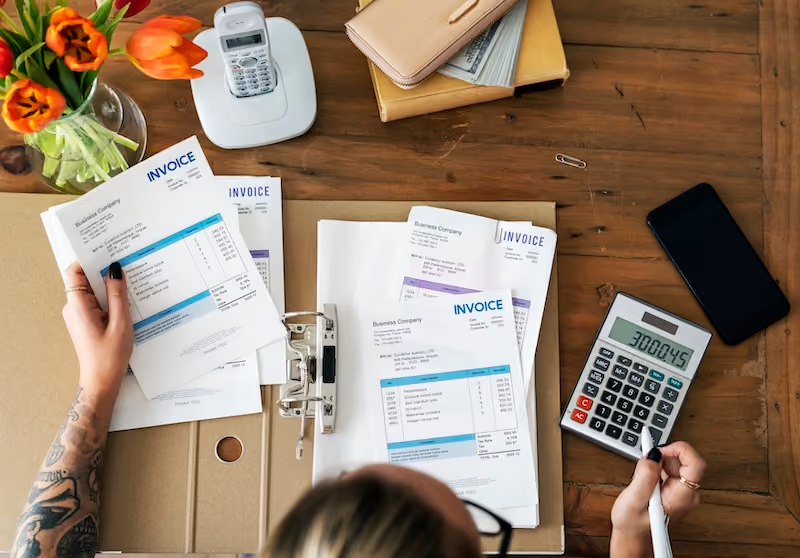
Electronic invoicing: how the reform will change things for restaurants in 2026
Noémie Daniel
Updated on:
06 May 2026
Share this article
The electronic invoicing reform will come into effect in 2026. Behind a technical regulatory framework, this reform has very concrete impacts on your organization, your cash flow, and your day-to-day management.
The aim of this article? To get straight to the point: to explain the essentials and give you practical tips for planning ahead with peace of mind, without having to rush to comply with the reform at the last minute.
What is the electronic invoicing reform?
The e-invoicing reform aims to standardize the issuance, receipt, and transmission of electronic invoices between companies. Ultimately, invoices will no longer be sent freely via email or "traditional" PDF, but via certified platforms in standardized formats.
There are many objectives behind this measure:
Strengthen the control and reliability of VAT returns,
Streamline communication between businesses and the tax authorities,
Reduce the risk of errors and inconsistencies,
Speed up invoice processing times and, consequently, payments.
Simplify day-to-day administrative procedures for businesses.
For restaurant owners, this primarily means more structured management, but also more automated management, provided that the right tools are adopted.
1. The two pillars of reform: e-invoicing and e-reporting
Ultimately, all businesses subject to VAT are affected, regardless of their size or sector of activity.
For you, as a restaurant owner, this applies in particular to:
Supplier invoices,
B2B sales (businesses, local authorities, events),
Daily customer payments.
Even independent restaurants are fully affected. And the more diversified your business is (dine-in, takeout, delivery, events), the more important it is to plan ahead.
Why does the cash register play a key role in the reform?
In the restaurant industry, e-invoicing is not limited to accounting. Your cash register is at the heart of the system, particularly for e-reporting.
Each payment generates data (amounts, VAT, payment methods) that must be reliable, structured, and automatically usable. This information will then be fed into the flows transmitted to the tax authorities via an approved platform.
👉 An incorrectly configured or isolated cash register can result in:
Inconsistencies in figures,
VAT discrepancies,
Time-consuming manual corrections.
Conversely, a cash register connected to your management tools secures data as soon as an order is taken, without adding to the workload of your teams.
3. The official schedule: September 2026 and 2027
September 2026: entry into force for large companies and mid-sized companies
Starting September 1, 2026, large companies and mid-sized companies will be required to both receive and issue their invoices in electronic format. This step involves choosing a suitable platform (PA or Public Invoicing Portal), configuring the relevant tools, and preparing teams for the new processes.
September 2027: rollout to microbusinesses, SMEs, and self-employed workers
The reform will then be extended to very small businesses, SMEs, and the self-employed, including micro-enterprises, from September 2027. This final phase marks the complete rollout of electronic invoicing to all businesses subject to VAT.
In the restaurant business, waiting until the last minute is rarely a good strategy: peak periods, stressed teams, tools already in heavy use, etc. It is essential to plan ahead in order to test solutions during quieter periods, train teams calmly, and avoid changes imposed in the middle of the season.
4. The Factur-X format and technical standards
What is the Factur-X format?
This is a hybrid invoice format: a human-readable PDF containing structured data (company identification, VAT, amount, date, nature of products/services) that can be used by computer systems. This format (or equivalent) is becoming the standard.
Why are simple PDFs no longer sufficient?
If you are still using manually generated PDFs or Word/Excel invoices, these will no longer be accepted. Data must be automatically usable and transmitted via a certified platform.
For example, a PDF sent by email to your B2B supplier or a corporate customer cannot be automatically integrated into their accounting system. This could lead to processing delays or errors.
Partner Dematerialization Platforms (PDP) or Approved Platforms (PA) are intermediaries approved by the government. Their mission:
Transmit invoices between companies,
Verify their compliance,
Send the necessary data to the tax authorities.
Who does what, specifically? Here are the roles of each person in practice:
The cash register and business tools collect sales and billing data.
The PA is responsible for transmission and compliance,
The accountant retains his role of analysis and advice.
If your tools are properly connected, data transfer becomes largely automated and requires no manual re-entry.
Pennylane: the PA solution tailored to restaurant owners
Reforming electronic invoicing may seem like yet another constraint. With the right platform, however, it becomes an opportunity to simplify your restaurant's financial management in the long term.
Pennylane is a government-approved platform authorized to receive, transmit, and verify compliant electronic invoices, as well as manage e-reporting. In practical terms, it centralizes all invoicing flows and automates exchanges with the tax authorities, without any manual action on your part.
For restaurant owners, the benefits are very tangible:
Accelerated digitization of billing processes,
Saving time and increasing reliability on a daily basis,
Better tracking of invoice statuses (issued, received, paid),
Simplified collaboration with your accountant, who has access to clear and up-to-date data.
In practice, Pennylane becomes a single point of control for your invoices and e-reporting. Less re-entry, fewer errors, greater visibility: the reform is no longer something you have to endure, but something that fits naturally into your organization.
6. Innovorder: your cash register as the technical basis for compliance
Reform begins well before accounting: it begins at the point of collection. If your cash register does not produce reliable, structured data, the entire downstream chain—e-reporting, tax transmission, accounting reconciliation—becomes a headache. This is the problem that Innovorder solves at the source.
Accurate tax data from the moment the order is placed
Each payment made on an Innovorder cash register automatically generates structured, usable data: amounts excluding/including tax, VAT rates applied, payment methods, distinction between B2C (counter sales, delivery) and B2B (private events, catering services) flows. No re-entry or manual processing required downstream.
Direct integration with Pennylane, PA partner
Innovorder integrates natively with Pennylane, a government-approved platform. Data from your cash register is automatically transferred to Pennylane, which handles e-reporting to the tax authorities without any manual action on your part.
7. Concrete benefits for your restaurant
Beyond regulatory requirements, the reform can bring real, tangible benefits:
Less time spent on administrative tasks,
Fewer billing errors,
A better understanding of VAT,
A smoother relationship with your accountant.
In short: fewer constraints and more precise control.
How much does it cost and what are the risks of non-compliance?
Investment vs. savings generated
Compliance represents an investment (subscription to a PA, updating the cash register or management software, training teams), but this is often offset by productivity gains, reduced errors, and smoother organization.
The tax penalties provided for
In the event of non-compliance, financial penalties are imposed, but above all, you run the risk of your B2B invoice exchanges being blocked.
€15 per invoice not issued in a compliant electronic format, with a maximum of €15,000 per year for the same company.
€250 per missing or incorrect e-reporting data transmission, also capped at approximately €15,000 per year.
The administration may show tolerance during the implementation phase, but these penalties are indeed provided for in the law.
How can you prepare your restaurant today?
E-invoicing reform may seem complex, but the key is anticipation. The earlier you start, the easier it will be to implement and the less disruption there will be to your daily business.
To help you, here is a practical 4-step checklist designed for restaurant owners, which you can start using right away:
Take stock of your current tools,
Identify a compatible PA,
Check the connection between cash register, management, and accounting.
Train your teams in new reflexes.
Those who will be affected by the e-invoicing reform will see it as yet another constraint. Those who anticipate it will see real benefits: less re-entry, better data control, greater visibility, and tools that are finally aligned with the reality on the ground.
So the real question is not "am I obliged to do this?" but rather "how can I turn this reform into a way to save time and gain peace of mind?" And you can make that transformation happen right now.
"With 20 years' experience working for some of the world's largest foodservice groups, I'm helping the sector with its digital transformation through innovative digital solutions."
"With solid experience in developing key accounts, I'm supporting the digital transformation of the foodservice sector by proposing innovative digital solutions to optimize operations."