Optimizing payment in your restaurant: a complete guide
Chloé Thévenet
Updated on:
07 May 2026
Share this article
As a restaurateur, you know that payment is not just a formality. It's the last step in the customer experience, and often the one that sticks in the mind. A smooth, fast and modern checkout contributes as much to customer satisfaction as a well-prepared meal. Conversely, a slow, complicated or poorly organized checkout can tarnish the whole experience, frustrating your customers and undermining customer loyalty.
So, how do you optimize payment in the restaurant business so that it enhances the performance of your establishment rather than hindering your service? We give you all the keys here.
Payment, a key stage in customer experience and operational performance
The moment of payment is not insignificant: it marks the end of the customer journey, and often the last impression your establishment will leave. An impeccable service can quickly be marred by a long wait at the cash register, a broken terminal or a badly shared bill. A smooth, fast and frictionless checkout, on the other hand, contributes to a positive, even memorable experience.
It's also a lever fororganizational efficiency: a well-thought-out checkout process enables your teams to be more responsive, to better manage flows in the restaurant, and to limit errors at the till. What does this mean in concrete terms? Better table rotation, less stress at peak times and greater productivity throughout the service.
Restaurateurs who have digitized their payment systems consistently see an improvement in table turnover. Faster payments free up tables sooner, create additional capacity without changing the dining room layout, and directly translate into higher revenue per service.
Different methods of payment in the restaurant business
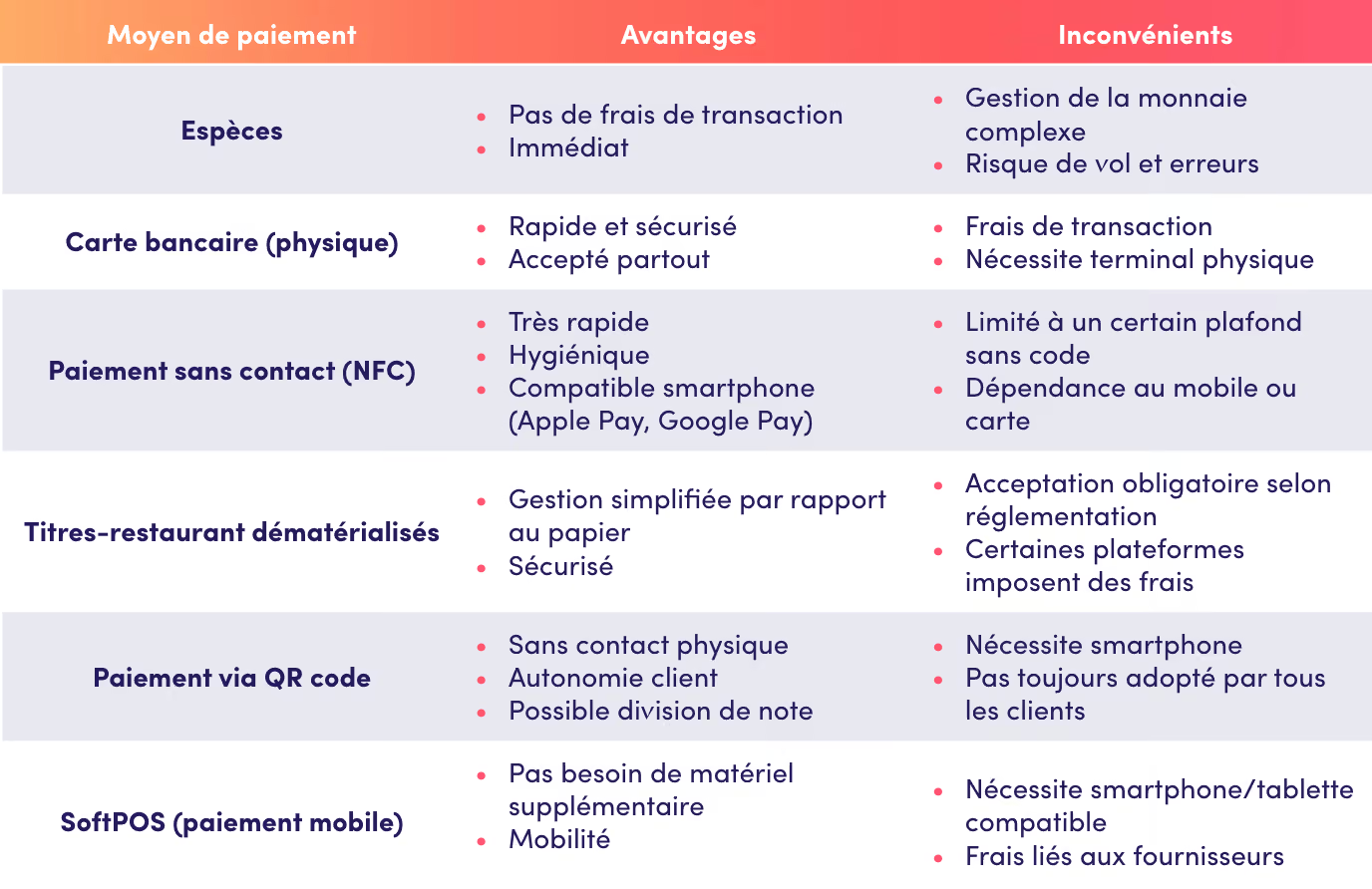
There are many different ways to pay your customers, each with its own specific features. Here's a summary of the main payment methods in the restaurant business, with their advantages and disadvantages, to give you a better idea of the options available.
Offering several payment methods adapted to your clientele will help you streamline your collections, avoid frustrations and improve the overall customer experience.
What technological solutions are available to streamline restaurant payments?
TPE: the heart of the POS system
The electronic payment terminal (EPT) must accept all types of payment: card, contactless, titres-resto, mobile. It must be fast, reliable and well integrated with your cash register.
A good Eftpos terminal not only guarantees transaction security, but also better management of payment flows, which is essential during peak periods. It also makes it easier to track sales in real time, giving you a clear view of your turnover.
SoftPOS: mobile payment without additional hardware
With SoftPOS technology, you can pay directly from a kiosk or cash register without an Eftpos terminal. A modern, secure payment solution that reduces hardware costs.
This system is gaining in popularity thanks to its flexibility, particularly for mobile facilities or small structures. It also simplifies technical installation, without the need to invest in several pieces of physical equipment.
Payment via QR code or mobile app
Payment by QR codeis perfectlyadapted to fast-food restaurants, terrace payments and table orders.
It creates no queues;
It offers customers 100% autonomy;
It limits physical contact, ideal for
A real boost for the customer experience ! Note that this method of payment also offers numerous possibilities for interaction, such as collecting reviews or promoting special offers via the app.
Contactless mobile payment is becoming increasingly popular: in 2024, 63 % of French people said they were familiar with and used it, a significant 8-point increase on 2023. A trend that confirms the importance of offering this type of solution in your establishment.
Control terminal with integrated payment
The self-order kiosk does more than just take orders: it integrates payment directly into the customer journey, with no waiting and no staff intervention. Innovorder customer data shows that the average basket size increases by 30% at kiosks compared to orders placed at the register, with receipts rising from €15 to over €20 depending on the establishment (source: Innovorder customer testimonials, April 2026). Without time pressure or the cashier watching, customers choose more freely and generously.
How do you choose a payment solution for your restaurant?
The payment solutions market is crowded. Here are five criteria to help you narrow down your options effectively:
1. Integration with your POS software. A standalone solution requires manual re-entry and increases the risk of errors. Insist on native integration with automatic transaction reporting.
2. Compatibility with digital meal vouchers. Swile, Edenred, CONECS: a large portion of lunch customers pay with meal vouchers. An uncertified POS terminal excludes you from this market.
3. Fund settlement times. A settlement on D+3 or D+7 can strain your cash flow at the end of the month. Compare the terms and negotiate based on your transaction volume.
4. NF525 and PCI-DSS compliance. NF525 certification has been mandatory since January 1, 2018. In 2025, 60% of software vendors applying for NF525 certification were deemed non-compliant (ACEDISE, 2025). Self-issued certificates have no legal standing: a fine of up to €45,000 may be imposed in the event of a tax audit.
Innovorder has been NF525-certified since 2016—even before the legal requirement took effect—and undergoes an annual audit by an independent third-party organization. Olivier Loverde, co-founder of Innovorder.
5. Quality of technical support. A terminal breaking down on a Friday night with no support available: that’s a scenario you want to avoid. Evaluate the support hours and response times before signing the contract.
Adapting your payment strategy to your type of restaurant
Not all restaurants have the same constraints, nor the same customers. Here's how to define your payment solutions according to your concept:
Fast food
Objective: maximum fluidity.
Preference should be given to integrated payment terminals, tabletop or takeaway QR codes, and mobile checkouts.
Traditional table service
Objective: smooth checkout without disturbing the experience.
Preferred: wireless EPOS or softPOS, table-top payment, possibility of splitting the bill.
Food truck or nomadic catering
Objective: mobility and efficiency.
Lightweight terminals or smartphone checkouts, contactless payment only.
An analysis of your hourly flows and your customers' profiles (students, employees, tourists) will help you define which means of payment you should offer.
Did you know? Ordering and paying at the table is now a well-established practice, with one in two French people familiar with it and using it.
7 concrete actions to improve cash flow in your restaurant
1. Diversify payment methods
Cards, cash, QR codes, vouchers, mobile payments, etc. It's important to offer a variety of payment methods to meet the needs of all your customers.
2. Integrate your payment solution at the point of sale
Smooth cash receipt requires a cash register connected to the payment system. Thanks to this tool,you can reduce errors and save time.
3. Offer fast, flexible checkout
Order kiosks and cash desks without Eftpos terminals, payment at the table: offer alternatives to central cash desks to relieve congestion at your points of sale and reduce waiting times.
4. Digitalize for greater autonomy and efficiency
A customer who can order and pay alone is a satisfied customer. It also frees up your teams to concentrate on service, advice and customer relations.
5. Secure transactions and comply with regulations
Check that your POS software is NF525-certified, that your payment service provider is PCI-DSS compliant, and that it accepts digital meal vouchers. These three points constitute the minimum legal and commercial requirements.
6. Train your teams to cash in without friction
Each waiter or team member needs to be trained and comfortable with all tools: POS terminals, applications, QR codes, etc. This is essential to guarantee smooth checkout under all circumstances.
7. Centralize your flows for better management
An all-in-one solution provides you with a consolidated view: revenue by payment method, payment processing times, and decline rates. This data helps you identify pain points and fine-tune your operations department by department.
The impact of payment on your restaurant's performance
Save time and increase productivity
With less waiting, fewer re-entries and fewer errors, your service becomes smoother. Your teams are more efficient and can concentrate on high value-added tasks.
In busy periods, every second counts: optimized cashiering helps to better manage flows and avoid bottlenecks. It's also a way of reducing pressure on staff, by automating certain time-consuming tasks.
A better customer experience
It's often the last moment you'll experience in your restaurant, so make it simple, fast and pleasant. By avoiding queues or bugs at checkout, you leave a positive impression and nurture customer relations right to the end.
A concrete loyalty lever
The moment of payment is also an opportunity to bond with your guests:
By offering a digital loyalty card,
By collecting a review via a QR code,
Or by facilitating a recurring payment.
A good checkout experience encourages customer return and loyalty to your establishment.
Better financial management
Automated, centralized collections enable you to monitor your sales in real time, reduce accounting errors and better anticipate your cash flow requirements.
As a result, you gain greater visibility of your business, enabling you to make better decisions. Less manual data entry means less stress at monthly closing.
Greater flexibility to adapt to all scenarios
On-site, takeaway, delivery, kiosk, QR code, Click & Collect, etc. A well thought-out payment solution enables you to adapt to all customer journeys and current consumer trends.
It's also an asset for optimizing your sales : by eliminating payment constraints, you give customers the choice to pay wherever they are, whenever they want.
What if you were to switch to an all-in-one payment solution designed for the foodservice industry? Innovorder supports you with simple, fast and connected tools.
Payment in the restaurant business is not just a technical step: it's an experience in its own right, and a real performance driver. By diversifying your payment methods, digitizing your payment solution and training your teams, you can improve both your internal organization and customer satisfaction. Ready to take the plunge?
FAQ: Frequently Asked Questions About Payment in the Food Service Industry
What payment methods must a restaurant accept?
No law requires businesses to accept credit cards. Cash is legal tender and cannot be refused for in-person transactions. In practice, refusing credit cards means excluding a significant portion of your customer base.
Are digital meal vouchers mandatory?
No, but they are highly recommended if you serve a busy lunch crowd. To accept them, your POS terminal must be registered with the issuers (Swile, Edenred, Up Déjeuner) through the CONECS network.
What is NF525 certification, and why is it essential?
The NF525 standard ensures the integrity of sales data. Mandatory since January 1, 2018, failure to comply may result in a fine of up to €45,000 in the event of a tax audit. A self-issued certificate from the software provider has no legal standing.
Is QR code payment suitable for all restaurants?
It is particularly effective for table service, outdoor seating, and fast food. For customers who are less comfortable with digital technology, continue to offer a traditional payment method as well.
How can payment data from multiple locations be centralized?
Multi-location POS software with a centralized dashboard allows you to consolidate sales data by payment method, location, and time period. This is essential for effectively managing a network.
-
Need help choosing the best payment solution for your business? The Innovorder experts are available to guide you, with tools perfectly adapted to your needs.
"With 20 years' experience working for some of the world's largest foodservice groups, I'm helping the sector with its digital transformation through innovative digital solutions."
"With solid experience in developing key accounts, I'm supporting the digital transformation of the foodservice sector by proposing innovative digital solutions to optimize operations."