7 questions to ask yourself before opening a second restaurant
Noémie Daniel
February 3, 2026
Share this article
Having the ambition to open a second restaurant generally means that your first establishment is doing well. Congratulations! But between the desire to grow and the reality on the ground, a real restructuring phase is necessary. Going from one to two restaurants is not simply a matter of duplication. It's a change of course: more teams to manage, more data to analyze, more decisions to make, and less room for improvisation.
If the idea is starting to play on your mind, then now is the right time to take a step back. These seven questions will help you open a second restaurant on a solid foundation, without jeopardizing your current business.
1. Is my first restaurant sufficiently profitable and stable?
Before considering opening, certain indicators must be green:
Stable profitability for at least 12 months;
A comfortable cash flow, without constant stress;
Good control of your margins, dish by dish;
Controlled expenses, particularly raw materials and payroll.
If you are indispensable to every department for everything to run smoothly, it's a clear sign that the model is not yet mature enough to be replicated.
Did you know? Accordingto INSEE, less than one in two sole proprietorships created in 2018 were still active five years later, while this figure rises to 66% for corporations. This shows how crucial it is to ensure that your first establishment is stable and profitable before considering a second opening.
2. Do I have the financial capacity to invest in a second point of sale?
A second restaurant always costs more than expected. And it's not just a question of renovations or equipment. To avoid unpleasant surprises, it's essential to calculate your budget accurately and choose the right financing package. Many restaurateurs underestimate the cost of the first few weeks, when turnover may be low while they build their reputation.
Remember to include all expense items:
The layout and equipment of the premises,
Recruitment and training of teams,
Cash requirements for the first months of operation,
Management and payment collection tools, essential for smooth operation.
The right financial arrangement will be one that does not jeopardize your first restaurant. Opening a second establishment should in no way put pressure on your existing business. It is better to build in a safety net and consider gradual financing rather than committing everything at once. This allows you to test the viability of the project without jeopardizing your day-to-day operations.
3. When is the right time to open my second restaurant?
There is no perfect timing, but some periods are clearly riskier than others. If you are already under pressure, short-staffed, or overwhelmed by operations, opening a second restaurant is likelyto increase your mental load and create tension within your teams.
For example, if one of your restaurants experiences a decline in revenue for a few months, will you be able to absorb the shock without constant stress?
Beyond the numbers, you also need to consider your energy and availability. Opening a second restaurant requires time for recruitment, training, setting up processes, etc. If you are already exhausted or too focused on the day-to-day running of your first establishment, the project may stall or put you in a difficult situation. Sometimes, waiting a few months to consolidate your first establishment is the best strategy.
4. Can my concept be replicated without compromising quality?
A concept that works once does not always work twice, especially if it relies too heavily on you. Hence the importance of standardizing your processes.
Standardize your processes before expanding
Before opening, everything must be clearly defined and documented so that every member of your team knows exactly what they need to do:
Recipe cards: quantities, cooking methods, and presentation.
Kitchen organization: work plan, product flow, and role of each station.
Consistent service processes: customer reception, order taking, and complaint management.
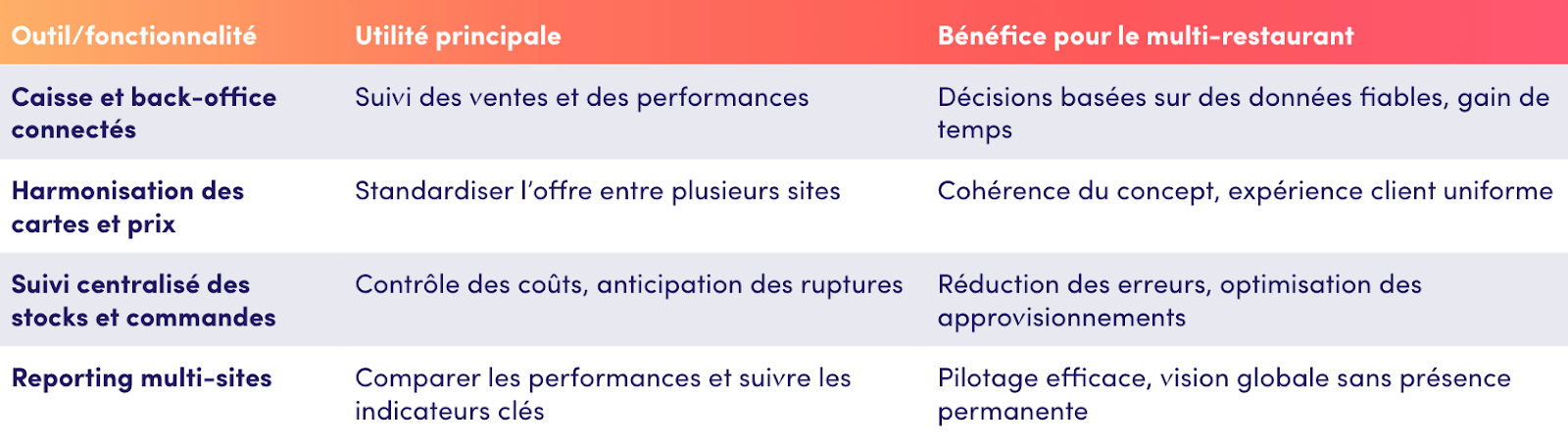
Inventory management: centralization of inventories and anticipation of orders;
Cash closing: standardization of how sales and receipts are recorded.
The more structured your processes are, the more autonomous your teams can be and the more you can take a step back to manage your two establishments effectively.
Adapt or duplicate identically: which strategy should you choose?
Duplicating your concept identically is reassuring, especially when your first restaurant is doing well. However, depending on the location of the second establishment, it may be more appropriate to adapt your offering slightly:
Adjust the menu to suit local habits (e.g., more fast food for an office area).
Adapt the hours or services offered (weekend brunch, expanded delivery).
In any case, having a centralized system facilitates this duplication or adaptation. As Thibault, co-founder of Foud, points out: "The software allows us to easily duplicate our processes and train our franchisees using the same technology."
5. Where should I locate my second restaurant to maximize success?
Location remains a key factor, but choosing a location simply because you "like it" is not enough. It must meet strategic criteria that will ensure not only profitability but also the long-term viability of your second establishment.
Opening too close to your first restaurant may divide your customer base instead of doubling it. To avoid cannibalization, analyze carefully:
Passing traffic: is there enough potential to attract new customers?
The type of clientele: does it match your concept and your expectations in terms of footfall?
Consumption habits: quick lunch, sit-down dinner, delivery—what are the local expectations?
Local competition: what similar restaurants already exist in the area?
Your second restaurant should expand your catchment area, attract new customers, and complement your existing business, rather than simply displacing customers from your first establishment.
6. Do I have the organizational skills to manage two restaurants simultaneously?
This is often where everything comes together. With two or more establishments, your role changes.
Recruit and train a trusted manager for the second site
With two restaurants, you can't be everywhere at once. That's why a well-trained manager who is empowered and fully aligned with your standards is essential. By taking the time to mentor them and develop their skills from the outset, you avoid having to intervene in every detail and ensure that the restaurant runs smoothly from the very first weeks.
Divide your time between the two establishments
Your role is changing: less hands-on work and more management, analysis, and team support. To ensure a smooth transition, it is essential to plan your schedule, clearly define your days at each site, and remain available for strategic decisions, while avoiding becoming overwhelmed by day-to-day tasks.
Establish an effective reporting and management system
When you manage two restaurants, instinct alone is not enough to know if everything is running smoothly. It becomes essential to track your figures in real time and compare the performance of each establishment. How? With a good reporting system that helps you quickly identify discrepancies, anticipate problems, and make the best decisions, without having to constantly run between your two locations.
By opening a second restaurant, you are making a real career change. You are moving from the role of a restaurateur who is very present on the ground to that of a leader, capable of taking a step back and trusting others.
The key is to approach this transition as a real business project, with a clear, quantified, and controlled vision. By structuring your finances, your organization, and your tools now, you are putting all the odds in your favor to grow without losing what makes you successful: quality, consistency, and customer experience.
-
Want to open a second restaurant without impacting the smooth running of the first? Innovorder's experts help you set up multi-location management with digital tools tailored to your specific situation.
"With 20 years' experience working for some of the world's largest foodservice groups, I'm helping the sector with its digital transformation through innovative digital solutions."
"With solid experience in developing key accounts, I'm supporting the digital transformation of the foodservice sector by proposing innovative digital solutions to optimize operations."