Cashiering in a bakery: How to handle the morning rush without making the line longer
Noémie Daniel
Updated on:
16 April 2026
Share this article
The morning rush at a bakery is unlike any other peak in activity. In less than two hours, a line can form, slow things down, or result in lost sales, depending on how smoothly the counter operates. Solutions exist, but not all of them address the same bottleneck. Innovorder helps you choose.
The morning rush at the bakery is a unique experience: quick transactions, cash payments, and a bustling counter
In the morning, everything moves quickly—or is expected to move quickly. Customers buy a baguette, two croissants, and a coffee. The transaction is simple, the amount is small, and they don’t expect to wait long. What this apparent simplicity hides is a particularly demanding checkout process: frequent cash transactions, giving change, and the next customer already waiting.
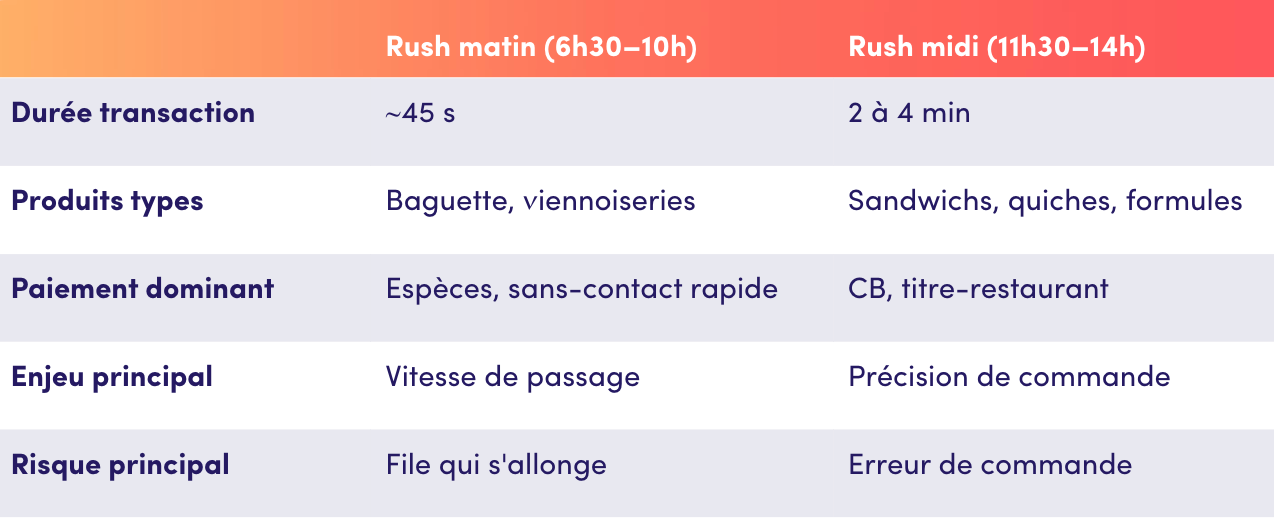
Morning vs. noon: two different paces, two different demands on endurance
Actual data from one of our clients specializing in bakery and snack foods in Paris
clearly illustrate the reality of this two-tier system. Between 8 a.m. and 10 a.m. on weekdays, hourly sales range from €1,000 to €1,600. On Sunday mornings, they can exceed €3,800 by 10 a.m. At lunchtime, between 12 p.m. and 1 p.m., the peak rises to €2,500–€4,500 per hour, but with longer transactions, more complex orders, and different payment methods.
It's not just a matter of volume: the two segments require different approaches and different equipment.
*The estimated processing time of approximately 45 seconds per transaction in the morning is a rough estimate shared by industry professionals: standardized product, fixed price, and often repeat customers. This is not official data.*
A wait of six minutes at a neighborhood grocery store is enough to discourage some customers, according to an OpinionWay study from October 2025. In bakeries, margins leave little room for error: the average EBITDA for an artisanal bakery is around 14% of revenue, according to Cerfrance (2025). Every customer who leaves without making a purchase directly impacts the bottom line.
The sector is under structural strain. Between 2022 and 2024, bakery closures rose by 28% according tothe Observatoire des Métiers de l'Alimentation. In this context, a long line forming in the morning is not just a minor inconvenience: it is an operational warning sign that warrants a concrete response.
What payment solutions can help you keep up with the morning rush?
There is no single solution to the morning rush. The available solutions address different bottlenecks (change handling, checkout congestion, payment processing time) and can be combined depending on the store’s layout. The key is to identify the right bottleneck before choosing a solution.
The automatic coin dispenser: give change quickly, accurately, and without depleting your cash reserves
Cash will still account for 43% of in-store payments in 2024 (Bank of France), a proportion that is likely even higher at the counter of a neighborhood bakery in the morning. Giving change is often the most obvious source of friction: it demands the salesperson’s attention, leads to mistakes under pressure, and eventually depletes the cash register during peak hours.
The automatic change dispenser directly addresses this issue. It dispenses change without any manual intervention, eliminates errors, keeps the cash drawer balanced, and immediately frees up the salesperson to assist the next customer. The time saved adds up with every transaction during the shift.
The mobile checkout: opening a second lane when the line at the register gets too long
When the line exceeds 3 to 5 minutes on a Saturday morning, the most straightforward solution is to open a second checkout lane. A mobile checkout station makes this possible without having to reconfigure the counter or invest in additional fixed equipment.
Its uses go beyond just taking payments. Little Drop, which operates in the street food and event industries, highlights the flexibility this brings to its operations: "Since the cash register is portable, it’s perfect for taking it out onto the patio to take and process additional orders. When there’s no line at the counter, this flexibility allows me to go out and interact with my customers."
The setting is different from a bakery, but the logic of rotating staff based on foot traffic applies directly: a second checkout station in the dining area during weekend peak hours, taking orders in advance while customers wait in line, or managing an outdoor seating area during the warmer months.
Contactless and fast payments: a useful catalyst, but not enough on its own
Contactless payment automatically reduces the time required for each credit card transaction. In 2024, credit cards accounted for 48% of in-store payments (Bank of France). Actively encouraging contactless payments in the morning—through signage and announcements at the checkout—has a real impact on overall efficiency.
But this solution has a specific limitation: it does not apply to customers who pay in cash, and it does not address the physical congestion at the counter when the line exceeds the capacity of a single station. Contactless payment speeds up each credit card transaction; it does not replace a cashier or an additional station.
How should you choose based on your setup, and what return on investment can you expect?
Making the right choice starts with an honest assessment of the main sticking point. Three situations come up regularly in artisanal bakeries.
If you process more than 40% of your transactions in cash in the morning → an automatic cash dispenser is a top priority. It directly addresses the most common bottleneck, secures the cash drawer, and frees up the sales associate’s attention with every transaction.
If you experience 3–5-minute lines in the morning → a mobile checkout counter is the most flexible solution. It can be activated as needed, requires no construction work, and can be used for other purposes outside of peak hours (outdoor seating, catering, one-time events).
Your customer base is already heavily focused on credit cards and contactless payments → so it makes sense to prioritize investing in a high-performance, properly configured terminal. Optimization then depends on the reliability of the hardware and the speed of processing digital payments.
For a bakery with a single checkout (a setup still very common in artisanal bakeries), the combination of a coin acceptor and a contactless terminal covers most situations without requiring a second permanent staff member. The mobile checkout is used as a backup during identified peak times: Sunday mornings, holiday seasons, and the first days of warm weather. Brands such as La Croissanterie, Tranché, and Paris Baguette now rely on Innovorder to manage their daily transactions.
According to Gira Conseil, snacking now accounts for 55% of average revenue in bakeries. This structural shift intensifies the challenges of the lunch rush but does not alter the nature of the morning rush, which remains a distinct scenario characterized by speed, cash transactions, and a bustling counter. It is this challenge that must be the primary focus when making decisions about payment methods.
Every bakery has its own layout, customer base, and peak hours. Do you have a question? Innovorder’s experts can analyze your workflow, assess your morning challenges, and recommend the best solution for your bakery.
"With 20 years' experience working for some of the world's largest foodservice groups, I'm helping the sector with its digital transformation through innovative digital solutions."
"With solid experience in developing key accounts, I'm supporting the digital transformation of the foodservice sector by proposing innovative digital solutions to optimize operations."