Which cash register should you choose for your restaurant in 2026?
Chloé Thévenet
Updated on:
07 July 2026
Share this article
There's hardly a good restaurant without a well-designed, high-performance cash register. But beware: not all cash registers are created equal, especially in a sector as demanding as catering. Between room service, order peaks, inventory management, menu options and the multiplication of channels (on-site, take-away, delivery, etc.), the role of your cash register is not limited to cashing out. It's a real day-to-day co-pilot.
So if you're wondering which cash register to choose, how much it costs, or how to avoid the mistakes that can ruin your productivity, this article is here to guide you towards the purchase of a restaurant cash register that's both efficient, compliant and profitable.
Why the right cash register is strategic for your restaurant
The day-to-day benefits of a certified cash register
By choosing a cash register adapted to your reality on the ground and to the needs of your establishment, it becomes the brain of your restaurant:
It centralizes your data,
It limits errors in collection,
It improves speed of service,
It allows you to analyze what's working and what's not.
The benefits of a connected cash register for your sales and organization
With a connected cash registerorders are sent directly to the kitchen, stocks are updated in real time and payments are integrated. What's the difference? Less stress for your teams, a smoother customer experience.
The consequences of choosing the wrong restaurant cash register
A poorly adapted or inefficient cash register can quickly become a nightmare. It slows down service, complicates the work of your teams and is unable to integrate with your other tools.
And if it breaks down on a Saturday evening, with no reactive support or automatic back-up, you're guaranteed problems: orders to be written down by hand, errors in the kitchen, impatient customers, and so on. And your sales data and accounting may also suffer.
In short, the wrong choice of cash register can quickly have repercussions on your restaurant's organization, customer satisfaction and financial health.
Traditional or touchscreen cash register: which one should you choose for your restaurant?
Before comparing the options on the market, there’s one key question to ask: what type of system truly fits your specific needs? A traditional cash register and a touchscreen cash register are in completely different leagues, and the choice you make will determine how you use it.
What a traditional health insurance plan does—and where it falls short
A traditional cash register consists of a numeric keypad, a cash drawer, and a receipt printer. It’s designed solely for processing payments. No inventory management, no sales reports, and no integration with your other systems. During slow periods or when transaction volumes are low, it may be sufficient.
But as soon as your restaurant starts to pick up the pace (lunch rush, takeout orders, delivery, set menus), its limitations become real problems: manual data entry that leads to errors, impossible inventory tracking, and no visibility into your performance. And if it crashes on a Saturday night, with no backup or support, your entire operation comes to a standstill.
How a touchscreen register changes your daily routine
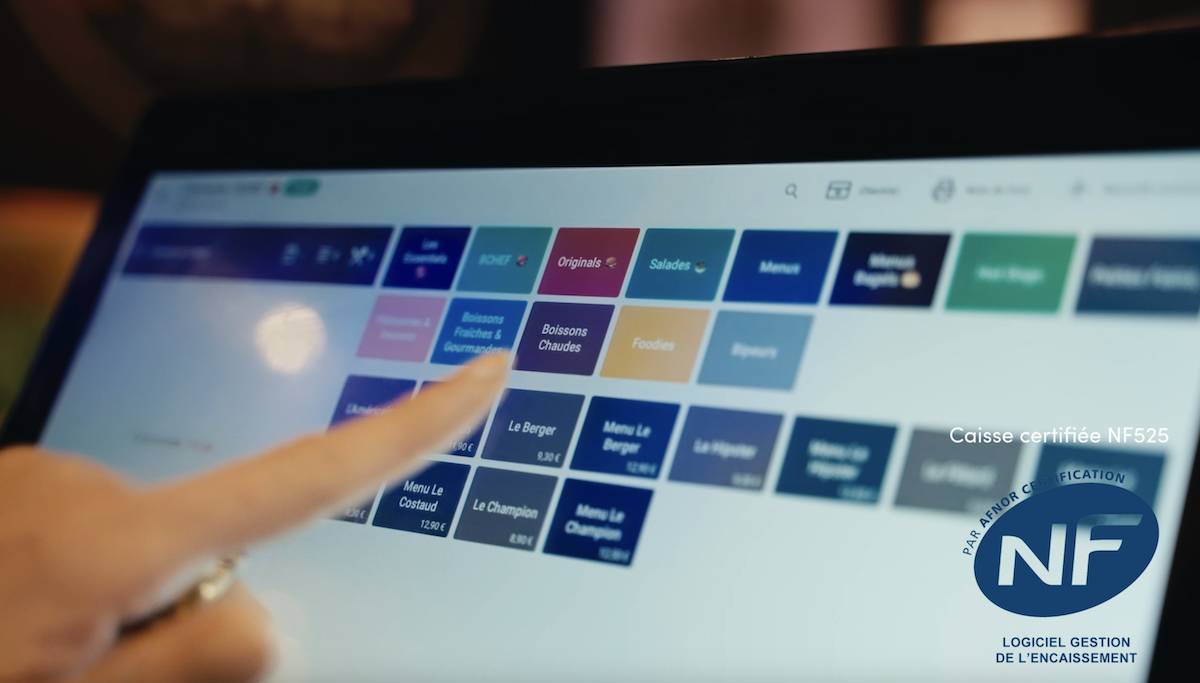
A touchscreen POS system is a computerized system with an interactive display. It goes far beyond simply processing payments: it handles multi-channel order taking, real-time inventory updates, detailed sales reports, loyalty program integration, and connections to delivery platforms. It becomes the operational brain of your restaurant.
Another often-critical feature in the restaurant industry is offline mode. Unlike a traditional POS system, which doesn’t rely on the internet but offers no advanced features, a modern touchscreen POS system continues to process payments and operate fully even during a network outage: data syncs automatically once the connection is restored.
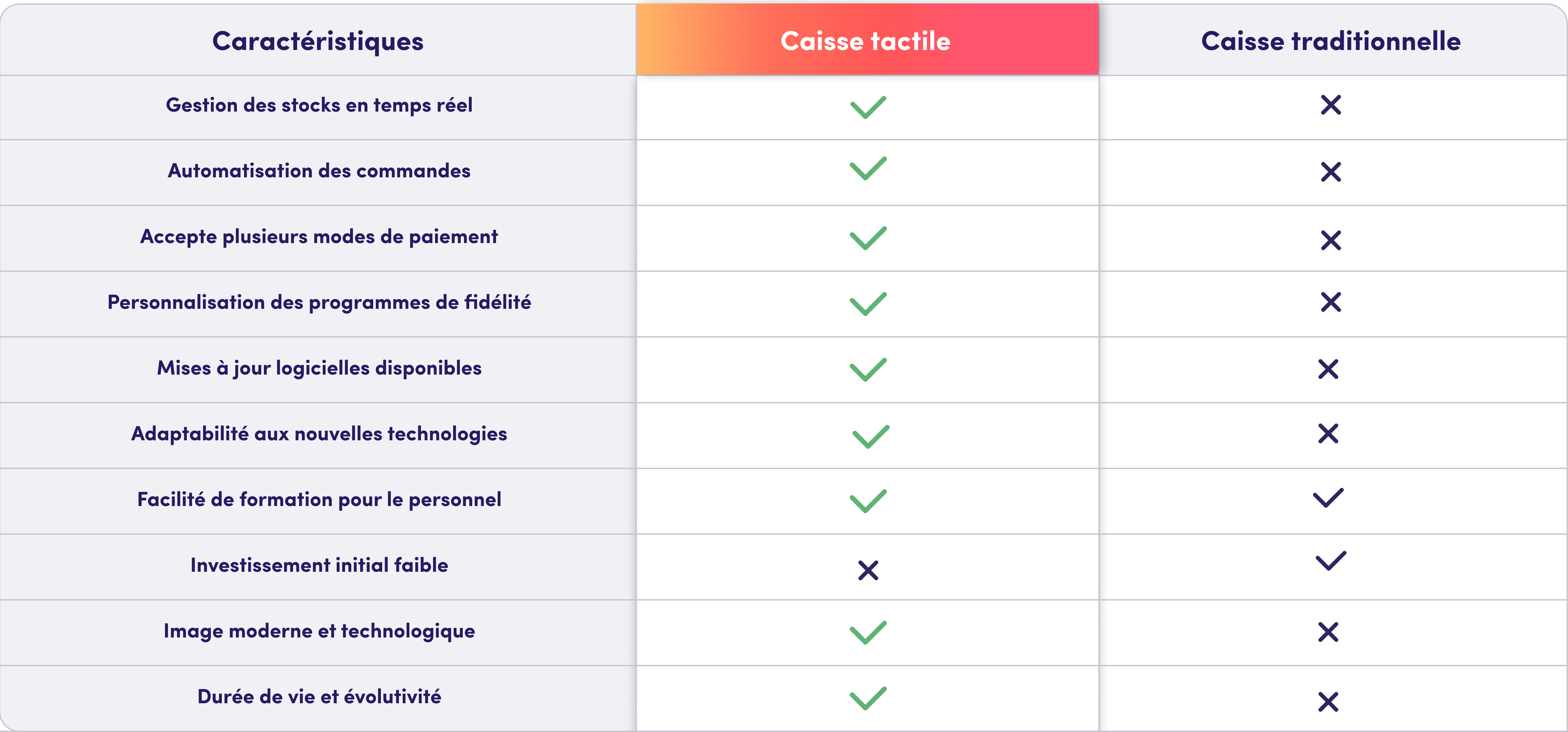
Comparison of Traditional Checkout vs. Touchscreen Checkout
For which restaurants is a traditional cash register still a viable option?
Only for very small businesses with low transaction volumes, no growth ambitions, and no need for management oversight: a seasonal refreshment stand, a single-item food truck. In all other cases, a touchscreen POS system is the option that protects your business and your profit margins in the long term.
Counter-style or mobile cash register: which one should you choose for your restaurant?
It's not always a matter of "one or the other." In many establishments, fixed and mobile registers complement each other, with each serving a specific purpose during service.
The fixed cash register: the foundation of your business
The counter-top POS system remains the central point of service for your restaurant. It consolidates all orders, regardless of their source (counter, kiosk, delivery, click & serve), and serves as the go-to reference for your front-of-house team. It handles the processing power, integrations, and overall management of your business.
For the vast majority of restaurants, one or more strategically placed fixed cash registers are sufficient to handle the entire shift.
Mobile checkout: A game-changer for high-traffic locations
The mobile cash register is a game-changer in settings with high customer traffic where every second counts. Instead of having staff return to the counter between orders, it allows them to take orders and process payments directly with the customer—whether in the dining room, on the patio, or in the queue.
Use cases where it really makes a difference:
High-volume fast-food restaurants: managing order spikes without lengthening lines, processing payments in line before customers even reach the counter
Patio or outdoor area: covering an area that the standard enclosure cannot reach without additional infrastructure
Events or catering services: Accepting payments outside your usual point of sale
Here’s what it actually changes: shorter wait times, fewer errors related to saved orders, a smoother customer experience, and—for your team—fewer unnecessary trips back and forth during peak hours.
The right approach before making a choice
Ask yourself two simple questions:
Is your bottleneck at the register (long lines, slow checkout) or in the kitchen (preparation, assembly)? If the problem is at the register, a mobile register can solve it. If the problem is in the kitchen, it won’t make a difference.
Does your team have enough staff to free up an employee to handle a mobile cash register during service? A mobile cash register is of no use if there is no employee available to operate it.
👉 Innovorder introduces Move, its mobile POS system designed for fast-paced businesses: compact and connected in real time to the rest of your ecosystem. Learn more about Move →
How much will a restaurant cash register cost in 2026?
Price ranges by body type
The price of a restaurant cash register depends on the type of restaurant and the specific needs of the establishment in question.
For smaller operations, such as food trucks or refreshment stands, an entry-level cash register (between €300 and €600) may suffice. It offers the essentials for fast cash receipt, without advanced features.
In a brasserie or traditional restaurant with table service, mid-range solutions, between €900 and €1,500, are the most suitable. They enable finer-grained management of sales, inventory and meal vouchers.
As for more structured establishments, such as multi-site restaurants, chains or concepts combining the dining room with takeaway sales, they generally turn to premium tills, priced at over €2,000, which are often touch-sensitive, connected and customizable.
A downtown sandwich shop will prefer a cash register with a monthly subscription and equipment included, while a semi-gastro will prefer to invest in a robust, custom-installed solution.
Expected expenses
Beyond the equipment, switching to a new cash register system involves several factors that are often underestimated. Here’s a realistic overview to help you budget for your project with confidence.
POS software is typically offered on a monthly subscription basis: expect to pay between €70 and €150 per terminal, depending on the features and type of restaurant.
The equipment (terminal, cash drawer, receipt printer, and payment terminal) costs between €500 and €2,500 for a complete setup, depending on the quality and number of stations.
Installation and setup (configuring menus, categories, prices, and taxes) cost between €200 and €800, depending on the complexity of your menu. You should also budget €150 to €400 per session for training; while this cost is often underestimated, it is a key factor in a successful transition.
Finally, monthly technical support costs between €50 and €100, depending on the packages offered by your service provider.
These price ranges vary depending on the complexity of your menu, the number of stations, and the service provider. At Innovorder, the SaaS plan starting at €79/month includes automatic updates, support, and feature upgrades as part of the subscription, with no hidden fees.
Purchase, lease or SaaS: three ways to finance your cash register
There are several options for equipping your restaurant, depending on your budget and operational needs.
Purchase remains the classic solution: you pay once and own the box. A good choice if you're looking for total autonomy, with no monthly commitment.
Renting can be an interesting option if you're running a seasonal establishment, a temporary food court or testing a new concept. It allows you to limit your initial investment.
SaaS (Software as a Service) subscriptions are becoming increasingly popular. Each month, you pay for an all-in-one solution, including hardware, software, updates and support. It's ideal for those who want a turnkey, scalable solution.
Calculating the return on investment of a modern cash register
A state-of-the-art cash register isn't just for cashing out. It also helps you to better manage your business. Analysis of sales by time slot, real-time monitoring of material costs, inventory management, team performance - all this data, once exploited, can help you save time, avoid losses or increase sales. And all these gains, put together, represent a return on investment much faster than you might imagine.
How to choose the best restaurant cash register?
The different types of cash registers available
Before choosing your cash register, it's best to know the main families available on the market. Each has its own advantages, depending on your activity:
Tactile: intuitive, fast, ideal for fast-food restaurants, bars or food courts,
Connected: synchronized with your accounting, management or inventory software.
Many modern cash registers combine these advantages.
Indispensable fast-food features
For a fast food restaurant, certain features are indispensable. These include :
To be effective, your solution must enable you to :
View activity in real time, hour by hour,
Identify what really pays off on the map,
Simplify your accounting exports in just a few clicks,
Integrate easily with your delivery or loyalty tools.
Your decision is not just about the hardware, but above all about the software that will manage your entire business. It's essential to compare several solutions before making your choice.
Feel free to test the software in a real-world scenario—during a busy period—to see how it performs under pressure. You’ll know right away if it runs smoothly or if it glitches.
Cash Registers and Multi-Location Operations: What to Expect
Once you have a second location, the issue of centralized management becomes critical. With standalone registers that aren’t connected to one another, every change—whether to a price, menu, or promotion—must be manually updated at each location. What takes just a few minutes at one location can take several hours across ten.
It’s not just a matter of time—it’s an ongoing operational risk. A franchisee who keeps using an old price list for several weeks, a promotion running on three locations but overlooked on the fourth, reports that have to be compiled manually every Monday morning. It’s these invisible friction points that weigh on a network’s profitability.
If you manage or plan to manage multiple locations, be sure to check these four points before choosing your point-of-sale system:
A single back-office system. All your changes (menus, prices, promotional offers) should be able to be applied across all your locations from a single location, without having to make changes site by site.
Real-time synchronization. Price updates must take effect across all your locations instantly, not after a manual resynchronization. This is particularly critical for franchise networks, where price consistency is a contractual requirement.
Consolidated reports. You need to be able to compare the performance of each of your locations (revenue, average check, best-sellers) from a single interface, without having to manually export and cross-reference files.
Offline reliability. In a multi-location setup, an internet outage at one location should never disrupt service. Your POS system must process and record sales in offline mode, then automatically sync the data once the network is restored.
As Thibaud, co-founder of Foud, puts it: "The software allows us to easily replicate our processes and train our franchisees using the same technology." That’s exactly what your POS system should do: make opening a fifth restaurant just as easy as opening the second one.
5 Signs It's Time to Replace Your Cash Register
Most restaurant owners know their POS system is no longer up to the task long before they decide to replace it. What’s holding them back? The fear of disrupting the team, losing data, or throwing service into disarray during the transition.
If your cash register causes you to lose 10 seconds per transaction and you process 200 transactions a day, that’s more than 30 minutes wasted every day. Over the course of a year, that adds up to more than 180 hours of subpar service—not to mention errors, impatient customers, and missed opportunities.
Here are the 5 signs that indicate the time has come.
1. Your checkout is slowing down service
Bugs, slow screen response, or crashes in the middle of a rush aren’t isolated incidents—they’re symptoms of a system that’s at its limit. In fast food in particular, a few seconds lost on each order add up quickly and take a toll on the customer experience and the ability to handle the flow of customers.
2. You don't have visibility into your sales
If you have to export files, perform manual calculations, or wait until the next day to see how your business performed the day before, your system is no longer up to the task of meeting today’s restaurant management needs. A modern POS system gives you real-time access to your data, from anywhere.
3. Your point-of-sale system isn't integrated with your other tools
Delivery, click-and-collect, loyalty programs, inventory management, accounting—today, restaurants rely on multiple tools that need to be integrated. If your POS system operates in isolation, forcing you to re-enter data or switch between multiple interfaces, you’re wasting time and increasing the risk of errors with every service.
4. Your equipment is showing signs of wear and tear
Slow terminals, unresponsive touchscreens, printers that break down, and increasingly expensive maintenance—beyond the daily inconvenience, aging equipment poses an operational risk. A restaurant POS system has an actual lifespan of 5 to 7 years. Beyond that, maintenance costs often exceed the cost of replacement.
5. Your restaurant is growing, but your point-of-sale system isn't keeping up
Opening a second location, expanding takeout service, adding a self-order kiosk, and digitizing orders. If every step your business takes is held back by the technical limitations of your POS system, it’s a sign that it can no longer keep pace with your growth. Your POS system should grow with you—not hold you back.
Do any of these situations sound familiar? Our experts can help you figure out the best solution for your restaurant. Talk to an expert →
What standards must a restaurant cash register meet?
Legal obligations surrounding NF525 certification
In France, your cash register must comply with standard NF525 STANDARD if you are subject to VAT. This certification guarantees :
Data inalterability,
Securing them,
Storage,
Archiving.
Checks to be carried out to ensure compliance in 2026
Before buying or renting, adopt these 3 reflexes:
Request an NF525 certificate of conformity;
Check for regular software updates;
Beware of uncertified imported crates.
Penalties for non-compliance
A non-compliant cash register can cost you €7,500 in fines (per unit), not to mention the obligation to comply within 60 days. An easily avoidable risk.
Integration with your tools (accounting, CRM, delivery).
We recommend that you test the system under real-world conditions, but above all, make sure your teams test it. They are the ones who will be using it on a daily basis.
The role of the cash desk in your sales strategy
You'll soon stop thinking of your cash register as a simple cash collection tool. You'll be relying on it to develop a solid sales strategy :
Offer upsells at the time of ordering (e.g. XL menu, extra sauces, etc.),
Collect emails or numbers for a loyalty database,
Identify off-peak periods to launch targeted offers.
What you need to know to buy the right cash register:
Take stock of your specific model and requirements (table-top, fast, multi-site, etc.),
Compare offers and always ask for a demo,
Check legal compliance (NF525),
Think scalability and support: your cash register needs to grow with your business.
-
Would you like to simplify the management of your restaurant with a modern, high-performance cash register? Contact Innovorder to find out how our solutions can optimize your sales and earnings.
"With 20 years' experience working for some of the world's largest foodservice groups, I'm helping the sector with its digital transformation through innovative digital solutions."
"With solid experience in developing key accounts, I'm supporting the digital transformation of the foodservice sector by proposing innovative digital solutions to optimize operations."