How can you tell if your cash register will comply with the standards in 2026?
Chloé Thévenet
Updated on:
17 July 2026
Share this article
Do you run a restaurant? You should know that having a cash register that complies with current regulations isn’t just a matter of common sense—it’s a legal requirement. In 2026, the requirements will become stricter, making it essential to ensure that your point-of-sale solution fully complies with all applicable rules. At the same time, be sure to protect yourself against payment risks: our guide to POS fraud in the restaurant industry details best practices for securing your transactions. Let’s explore together why this is essential and how to verify that your equipment is compliant.
Compliant Cash Registers: What's Changing in September 2026
Stricter Compliance Requirements in 2026
Regulations governing point-of-sale software have undergone several changes in recent years. The 2025 Finance Act initially provided for the elimination of self-certification and the requirement, effective September 1, 2026, to demonstrate a point-of-sale software’s compliance by means of a certificate issued by an accredited body.
However, this change was ultimately repealed by the 2026 Finance Act. The individual certificate issued by the software publisher therefore remains a valid form of proof of compliance for point-of-sale software.
However, this decision does not call into question the substantive obligations imposed on professionals. Point-of-sale software must still ensure the integrity, security, retention, and archiving of sales data. Restaurant owners would therefore be well advised to check the status of their software solution, the validity of their supporting documents, and the updates planned by their software provider as soon as possible.
The institutions involved
All businesses that use software or a point-of-sale system to process payments from individuals must verify their level of compliance.
This applies in particular to:
Traditional restaurants;
Fast-food restaurants;
Bakeries;
Cafés and bars;
Food stores;
Retail businesses.
The size of the establishment doesn't matter. Whether it's an independent restaurant or a multi-location chain, the requirements remain the same.
Checks to Be Performed Immediately
Although self-certification is still permitted, the requirements for point-of-sale software remain strict. Restaurant owners would therefore be well advised to contact their software provider to find out exactly:
The type of certification held;
The validity date;
Changes planned before September 2026;
The steps required to remain compliant.
By planning ahead, you can avoid having to switch solutions at the last minute and ensure business continuity.
How can you verify that your cash register is compliant?
Even if your provider assures you that your software is compliant, it is recommended that you perform a few checks, because in the event of a tax audit, it is your responsibility to provide the requested supporting documents.
Step 1: Request a certificate of compliance from your publisher
The first step is to contact your software vendor or POS provider.
Always request an up-to-date certificate of compliance, as well as documentation verifying the software’s certification. If your vendor is unable to provide these documents or remains vague about the status of its solution, this should serve as a red flag.
Step 2: Verify the information on the certificate
Not all certificates are created equal. A document that is incomplete or does not match your installation may be insufficient in the event of an inspection. The certificate must include the following 6 items:
The certificate number
The certificate must include a unique number that identifies it. This reference number can be used to verify its authenticity with the certifying authority.
Date of Issue
The issue date ensures that the document is current and corresponds to the version of the software currently in use.
The name and address of the establishment
The certificate or statement must clearly identify the company in question (name and address). Also verify that the information provided matches your business.
The name and version of the software
This is a point that is often overlooked. The certification applies to a specific version of the software. If your point-of-sale system has been updated, make sure the new version is covered by the certification.
The name of the certifying body
The document must clearly state the organization that issued the certification, whether it is AFNOR Certification or the LNE, for example.
Validity Date
Finally, check the certificate's validity period. An expired certificate may call into question your solution's compliance.
What is the difference between certification and a certificate of compliance?
These two concepts are often confused.
Certification refers to the verification process conducted by an independent organization.
The cash register compliance certificate, on the other hand, is the document that proves the software being used is compliant. In the event of a tax audit, this certificate must be presented to the tax authorities.
Step 3: Check the required features
In addition to the documentation provided by your software vendor, your point-of-sale software must meet four technical requirements defined by Article 286 of the General Tax Code.
Data immutability: Each payment receipt must be permanently recorded. Any subsequent modification or correction must be tracked and justified in order to preserve the transaction history.
Transaction security: The software must prevent any tampering with data without leaving a trace. Every operation performed in the system must be identifiable and verifiable.
Regulatory archiving: Payment data must be archived in a secure format so that it can be accessed and retrieved in the event of a tax audit.
Data retention for 6 years: In accordance with tax requirements, recorded information must be retained for a minimum of six years and remain accessible throughout that period.
If your software does not comply with one of these four principles, it cannot be considered POS software that meets regulatory requirements.
Step 4: Check for regulatory updates
Software compliance is never permanently guaranteed.
Legal requirements change regularly, and software vendors must adapt their solutions accordingly. Make sure your provider offers regular updatesand actively monitors regulatory changes.
Step 5: Keep records of compliance
The certificate of compliance, certificates, maintenance contracts, and proof of updates must be kept in an easily accessible file.
In the event of an audit, the ability to quickly produce these documents greatly facilitates communication with the authorities.
What are the risks in the event of a tax audit of a non-compliant cash register?
The administrative fine of 7,500 €
If a restaurant owner is unable to prove that their point-of-sale software complies with regulations, the tax authorities may impose a fine of 7,500 euros.
This penalty is intended to encourage companies to quickly come into compliance.
Beyond the financial amount, such a situation may also lead to additional audits of the accounting records and collection procedures.
The 30-day deadline to get your situation in order
If a business owner does in fact have a compliant cash register but is unable to immediately present the certificate during an inspection, they may rectify the situation.
If the supporting documents are provided within 30 days of the inspection, the fine may be waived.
While this option does not eliminate the need to keep records up to date, it does provide an important safeguard for businesses acting in good faith.
Criminal Penalties for Providing a False Statement
It is essential to distinguish between the administrative fine of 7,500 euros and the criminal penalties applicable in cases of document forgery.
The intentional production of a false certificate may constitute forgery and the use of a forged document.
Pursuant toArticle 441-1 of the Penal Code, this offense is punishable by three years' imprisonment and a fine of 45,000 euros.
During a tax audit of your restaurant's point-of-sale system, you may be asked to provide several documents:
The certificate of compliance;
The NF525 or LNE certificate;
Proof of updates;
The technical documents provided by the publisher.
Preparing these items in advance saves time and reduces the risk of disputes.
The Process of a Tax Audit of the Cash Register
The administration generally checks several items:
Compliance of the software used;
Data security mechanisms;
Archiving procedures;
Retention of information;
The consistency of recorded cash receipts.
The tax audit may also cover certification records and documents provided by the software vendor.
Steps to Take If You Lose Your Certificate
If you can no longer locate your certificate of compliance, contact your provider immediately. Most software vendors can quickly provide a duplicate or make the necessary documents available again through your customer portal.
It's better to anticipate this situation than to find out about it on the day of an inspection.
How do you choose a compliant cash register for your restaurant?
Factors to Consider Before Switching Software
Do you need to replace your current solution?
First, check to see if there is an officially recognized certification. Also, make sure the software vendor offers regular updates and support tailored to the needs of the restaurant industry.
Business features must also be taken into account: order management, mobile payment processing, Click & Collect, delivery, and sales management.
Questions to Ask Your Supplier
Before signing a contract, be sure to ask several questions:
Is the software NF525- or LNE-certified?
What is the validity period of the certification?
How are regulatory changes addressed?
Is a new certification planned before September 2026?
How can I quickly obtain the necessary documentation in the event of an audit?
The answers provided often give an indication of how reliable the supplier is.
Choose a solution designed for restaurant owners
Beyond regulatory compliance, a point-of-sale system must, above all, simplify the day-to-day work of staff and support the restaurant’s growth. That is precisely our goal here at Innovorder.
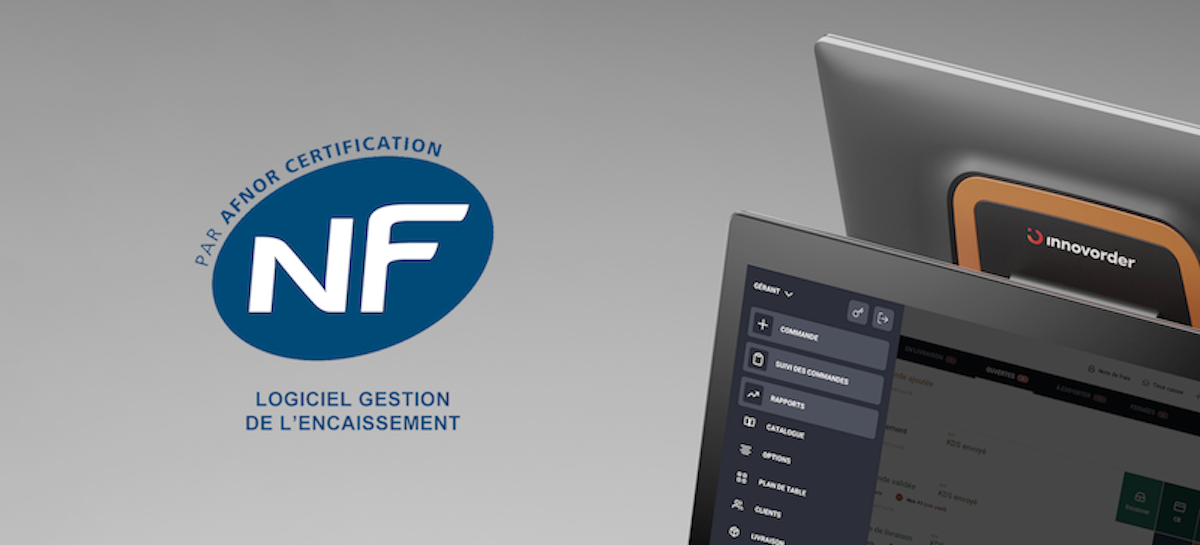
NF525-certified, the Innovorder POS meets current tax requirements and integrates natively with the entire Innovorder ecosystem: order terminals, kitchen production screens, printers, payment terminals, loyalty programs, and business management. All data flows seamlessly between tools without the need for re-entry. And because everything comes from the same provider, you have a single point of contact with a support team available 7 days a week.
“As a BCHEF franchisee, we needed a reliable solution that complied with regulatory requirements. Knowing that our cash register is NF525-certified gives us real peace of mind on a daily basis and allows us to focus fully on our business.” Andi, manager of BCHEF Montesson
Choose a publisher committed to compliance
Choosing a cash register isn't just about comparing features or prices. The vendor's ability to keep up with regulatory changes is also a key factor.
According to Christian Coquide, president of ACEDISE, restaurant owners would be well advised to choose a software provider with NF525 or LNE certification—ideally obtained before the recent regulatory changes. This can serve as an indicator of the provider’s reliability and commitment to compliance.
In addition to certification, it is also recommended to ensure that the provider offers regular support, up-to-date documentation, and upgrades to meet future industry requirements.
Faced with tax authority requirements and stricter audits, restaurant owners must now ensure that their point-of-sale systems are fully compliant and auditable.
Beyond legal requirements, the real challenge is simple: having a tool that is reliable, traceable, and capable of withstanding an audit without any gray areas.
The best approach is to plan ahead now: verify that your software is compliant and make sure you have all the necessary documentation before you need it.
Why is cash register compliance an issue for restaurant owners?
What the Regulations Say About Point-of-Sale Software
French regulations require certain businesses that use point-of-sale software or systems to ensure that sales data remains unalterable, secure, and properly stored and archived. This requirement is set forth inArticle 286, I, 3° bis of the General Tax Code (CGI), which stems from Law No. 2015-1785 of December 29, 2015, on the 2016 budget and the fight against VAT fraud.
In practical terms, VAT-registered businesses that record customer payments using software or a point-of-sale system must be able to demonstrate that their solution meets the four conditions outlined above. The goal isto prevent any fraudulent deletion or alteration of salesdata after it has been recorded. To fully understand what this means in practice, it is helpful to know the applicable VAT rates in the restaurant industry and their impact on your revenue.
Why the tax authorities regulate payment collection systems
For many years, certain software programs allowed users to modify tickets or delete certain sales after they had been recorded.
These manipulations made it difficult to verify the establishment's actual revenue . They could also have been used to artificially reduce the amount of VAT paid to the government.
It is therefore to put an end to these practices that the tax authorities have gradually tightened the rules governing payment systems. Today, every transaction must be securely recorded and remain traceable for several years.
What is a permissive fund?
A "permissive" cash register is software that allows users to modify, delete, or hide certain transactions without leaving any traceable evidence. In practice, this makes it possible to delete a sale or change an amount after payment has been received without these changes appearing clearly in the software's transaction history.
These systems are prohibited because they violate the requirements set forth in Article 286.
Permissive accounting practices have long been associated with revenue concealment and VAT fraud. According to the European Commission, the “ VAT gap ” amounted to approximately 128 billion euros in uncollected revenue in the European Union in 2023, part of which is linked to fraud, errors, and compliance failures in reporting and collection systems.
Did you know?
In France, compliance of point-of-sale software must be demonstrated by a certification issued by an independent body, such as the NF525 standard or LNE certification.
Both of these systems are based on the same fundamental requirements: ensuring the integrity, security, retention, and archiving of sales data, in accordance with current tax regulations.
The Innovorder point-of-sale software has been NF525-certified since 2016. Contact us to learn more about our NF525-certified point-of-sale software and ensure you’re in compliance before the deadline.
"With 20 years' experience working for some of the world's largest foodservice groups, I'm helping the sector with its digital transformation through innovative digital solutions."
"With solid experience in developing key accounts, I'm supporting the digital transformation of the foodservice sector by proposing innovative digital solutions to optimize operations."