Opening a Coffee Shop: Budget, Equipment, and Partners for Success
Chloé Thévenet
Updated on:
22 May 2026
Share this article
Do you dream of opening a coffee shop in 2026 and sharing your passion for coffee with your customers while building a profitable business? This article provides a step-by-step guide to planning, financing, and ensuring the success of your venture.
It is often the operational details that make the difference: service organization, choice of equipment, menu structure, or management tools.
What are the steps involved in opening a coffee shop in France?
Define your concept and conduct market research
In a now-mature market, with more than 2,100 establishments in France, concepts that are too vague or difficult to make profitable struggle to survive in the long run. The players that thrive are often those capable of offering a clear positioning and a straightforward value proposition for customers.
A successful coffee shop is a place where customers immediately understand:
What he is going to eat,
How long is he going to stay?
Why he'll come back.
Let’s take a concrete example: a “quick morning break” concept relies on high volume and efficient service. In contrast, an experiential coffee shop focuses on a higher average check but slower turnover.
A common mistake? Trying to do everything. The right approach? Choose a clear positioning and stick to it.
Market research then validates this concept: foot traffic, competition, consumer habits, and local purchasing power.
Choosing a legal structure and financing the opening of a coffee shop
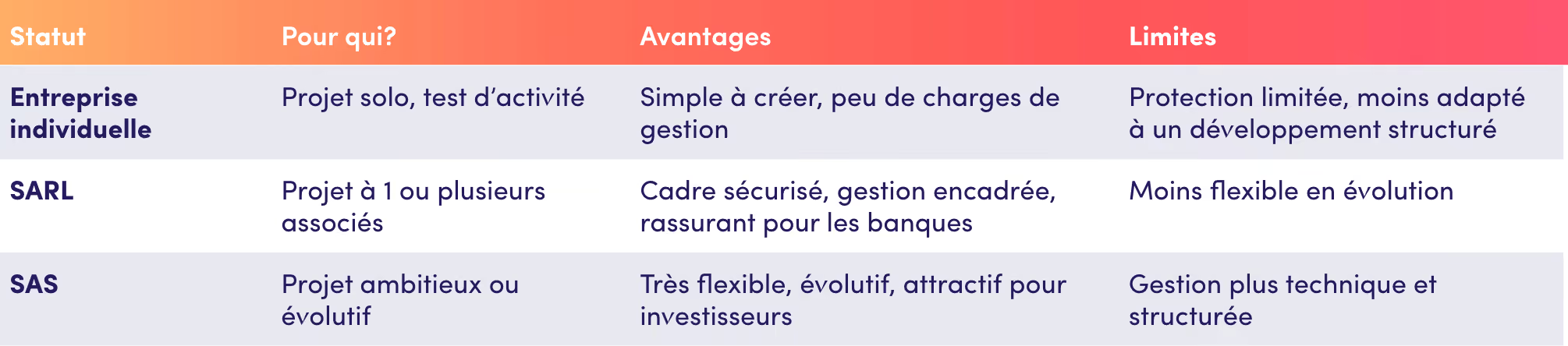
Choosing the right legal structure shapes your business, but success depends above all on your ability to secure funding for a credible project.
Investors aren't swayed by an idea, but by a financial projection. You must be able to demonstrate:
Your target customer base,
Your average ticket,
Your break-even point.
For example, 100 to 120 customers per day with an average check of €6 to €8 is already enough to build a solid projection.
Choose a location that naturally attracts foot traffic
Identifying a location that can operate almost "on its own" depends on two main criteria:
A steady flow of traffic (public transportation, offices, schools, busy thoroughfares),
Clearly identifiable times for consumption (morning, lunch break, afternoon snack).
In practice, what makes the difference isn’t just the volume of traffic, but how well the traffic aligns with your offering.
A fast-paced coffee shop will need a strong morning rush. An experiential coffee shop can focus on destination areas.
Complete the necessary administrative procedures and obtain the required permits
Administrative procedures include, in particular:
The registration of the business,
Any declarations to be filed with the town hall,
Activity-specific authorizations.
If your coffee shop offers certain specific beverages (such as alcohol), a license may be required under current regulations.
These procedures can take several weeks or even a few months. So don’t put them off until last, or you may have to delay the opening of your business.
Equipping your facility and hiring your team
Your equipment and staffing directly impact the smooth operation of your business and, therefore, the future profitability of your coffee shop.
Good equipment should not be considered solely in terms of quality, but also in terms of operational efficiency:
Fast service,
Workstation ergonomics,
Reduction of unnecessary travel.
A well-trained and versatile team remains essential to ensuring smooth service, even during peak periods.
Communicate and prepare for the coffee shop’s opening
Pre-opening communication plays a key role in the success of the first few weeks of operation. The goal is simple: to build anticipation and curiosity even before the first day.
This usually involves several concrete steps:
Setting up social media accounts in advance (Instagram, TikTok, Google Business Profile),
Sharing updates on the progress of the work and the identity of the site,
A sneak peek at the menu and featured items,
Planning a soft opening.
Finally, effective local marketing (neighboring businesses, posters, word of mouth, local influencers) can generate a crucial initial influx of customers right from the start.
What kind of budget should you plan for when opening a coffee shop in France?
Initial investment: premises, construction, and fit-out
The first expense category relates to the premises and their fit-out: security deposit, rent, construction work, code compliance, and interior design.
Even a space in good condition often requires some adjustments to be converted into a coffee shop: the counter, customer flow, and the preparation area.
The better you organize the space, the better your operational performance will be.
Basic equipment: coffee maker, kitchen furniture and supplies
The quality and speed of service, as well as your establishment’s daily profitability, depend on your equipment.
The main positions include:
Professional espresso machine,
Coffee grinders suitable for high-volume use,
Furniture in the room (tables, chairs, counter),
Kitchen equipment if food is provided (oven, refrigerators, prep area),
Cash register and point-of-sale software.
Good equipment isn't judged solely by its cost, but by the time it saves during operation.
Working capital and startup funding
A coffee shop doesn't become profitable right away. Even with a good location and a solid business model, it takes time to reach a steady pace.
That is why it is essential to plan for:
Fixed costs during the first few months (rent, salaries, utilities),
Recurring purchases of raw materials,
Natural fluctuations in attendance during the initial phase.
It is generally recommended to have at least 2 to 3 months' worth of emergency funds.
Financial assistance and funding available for coffee shops
Financing a coffee shop doesn't rely solely on personal funds. There are several options available to help you structure your business plan.
Among these:
Traditional bank loans backed by a solid business plan,
Honor loans (support networks),
Local business start-up assistance,
Regional measures by region,
Crowdfunding to test the concept.
Investors look first and foremost at the overall viability: location, projected revenue, average check, and the ability to achieve profitability.
A well-structured financial plan immediately inspires greater confidence and speeds up decision-making.
What are the mandatory administrative and regulatory procedures?
Legal Status and Registration
The choice of legal structure determines how you operate, how you are compensated, and how you grow your coffee shop.
SAS, LLC, or sole proprietorship: each option has its own implications in terms of taxation, personal protection, and management.
Registration then formalizes your business and allows you to legally begin operations.
Training to be completed
Opening a coffee shop doesn't always require a specific degree, but certain training programs are highly recommended to ensure the project's success.
The best-known training program is still HACCP, which is mandatory for anyone who handles food.
Beyond what is required, certain training programs offer a real advantage in the day-to-day management of a coffee shop:
Fundamentals of Restaurant Management,
Organization and management of the department,
Concepts of cost and margin management.
License and declaration at city hall
Depending on your business model, certain permits may be required to operate your coffee shop.
If you serve only hot beverages and simple food items, the requirements are minimal. However, as soon as you begin serving alcohol, a license is required.
You should also plan for:
The declaration of commencement at City Hall,
Any specific permits required by the municipality.
Hygiene standards and mandatory HACCP training
Hygiene standards are the foundation of smooth day-to-day operations.
These include, in particular:
Food preservation,
Temperature control,
The cleanliness of production and sales areas,
Product traceability.
All of these rules also help protect the quality of your service and your reputation.
Tax Obligations and VAT in the Restaurant Industry
Tax management is an integral part of running a coffee shop.
Depending on your business structure, you will be subject to different requirements:
Sales tax on food and beverages,
Regular financial reports,
Accurate tracking of revenue.
Point-of-sale software designed for coffee shops is an essential tool here: it allows you to centralize sales, automate reporting, and avoid tracking errors.
Rigorous tax management isn't just about staying compliant—it allows you to run your business with complete transparency.
How do you choose the location and concept for your coffee shop?
Analyze the catchment area and market dynamics
Before signing a lease, it’s not just about viewing the space; it’s about understanding what the neighborhood is really like.
A successful coffee shop hinges on a simple balance: the right concept in the right location. And to ensure this balance, you need to conduct a thorough on-site analysis:
Actual traffic volumes at different times of day (not just during rush hour),
The neighborhood's main features (offices, students, residential, tourism),
The presence and nature of existing competitors.
The goal is not simply to note that there is foot traffic, but to understand when, why, and how customers shop in the area.
Determine the optimal floor space and layout to maximize profitability
The floor space of a coffee shop should not be considered solely in terms of comfort, but in terms of profitability per square foot.
A space that is too large increases operating costs without necessarily boosting revenue. Conversely, a space that is too small can limit your capacity to serve customers and negatively impact the customer experience.
The challenge, therefore, is to strike a balance between:
Efficient work area (counter, food preparation, serving),
Smooth customer flow (movement, waiting, pickup),
Optimizing traffic flow during rush hour.
Define your positioning: traditional coffee shop, specialty coffee shop, or hybrid concept
The location of your coffee shop directly determines your business model.
There are three main approaches:
Traditional coffee shop: fast, simple, focused on volume and customer turnover,
Hybrid concept: a blend of coffee, food, and experiences (brunch, coworking, etc.).
The right choice depends mainly on the location and your operational capacity. A concept that is too complex in a high-traffic area can quickly become difficult to manage during service.
Developing a balanced menu and product offering
The map plays a much more strategic role than it might seem: it directly impacts your sales, production rate, and profit margin on a daily basis.
Don’t just offer “a little bit of everything.” Above all, your menu must successfully combine three key objectives:
Attract customers with products that are visible and appealing,
Maintain your profit margins with truly profitable products,
Maintain fast service, even during the morning rush hour.
A menu that is too extensive slows down service and increases waste. Conversely, a well-curated menu helps optimize costs, production, and consistency.
How can we organize our service to ensure profitability and customer loyalty?
Efficiently organize the workflow in the dining room and at the counter
Smooth service depends on a simple, clear, and consistent daily routine.
Every team member must have a clear understanding of:
His role,
The timing of his intervention,
His area of responsibility.
Good organization helps reduce wait times, increase the volume of orders served, and minimize stress during peak hours.
Manage procurement and material costs
Profitability depends not only on revenue, but also on controlling the hidden costs associated with raw materials (waste, overuse, losses during preparation or storage, and products that are misused or not fully optimized).
This is why it’s important to monitor these factors regularly and closely, so you can maintain a clear picture of your margins and make quick adjustments to your operations.
The standard goal for coffee shops is to keep ingredient costs between 25% and 30%.
Developing a pricing and average ticket strategy
Pricing strategy should be based on overall profitability, not just on competition, with average ticket size as the key performance indicator.
To improve profitability without increasing customer traffic, several key strategies are essential:
Creating formulas,
Map optimization,
Expansion of upselling (add-ons, sizes, premium options).
The goal isto increase revenue per customer, not just sales volume.
Digitize services and boost customer loyalty
Digitization helps improve both service efficiency and customer loyalty.
It works through several channels:
Reduced queues,
Better management of peak periods,
Fewer ordering errors.
Tools such as Click&Collect and loyalty programs help foster a more consistent and predictable customer relationship.
The result: a coffee shop that runs more smoothly, is better organized, and is more profitable—without increasing fixed costs.
Which partners should you choose when opening a coffee shop?
Coffee and raw material suppliers: selection criteria
A coffee supplier for coffee shops is much more than just a service provider: it is largely responsible for the quality your customers perceive.
When choosing one, there are several factors to consider:
The consistency of the product (coffee that tastes the same all year round),
Our ability to assist you with training and data extraction,
Responsiveness in the event of a shortage or a specific need.
A good supplier also helps you refine your menu and maintain consistent quality, even during busy periods.
POS Software Provider: Support and Scalability
Point-of-sale software isn't just a tool for processing payments—it's a true control center for your business.
Certain features quickly become essential for effectively managing your business:
Real-time sales tracking,
Inventory and stockout management,
Multiple payment methods,
Detailed reporting on peak hours and best-selling products.
In practical terms, this data then allows you to:
To schedule your teams for the right shifts,
To optimize your map,
To forecast supplier orders more accurately,
To identify the products that actually generate profit.
This tool quickly becomes central to day-to-day management. As Thierry Veil of Bagelstein, who launched his coffee shop, puts it: "The cash register is the brain of the restaurant."
Payment solutions: bank fees and payment terminals
The payment solution you choose has a direct impact on your profit margin and the customer experience.
Beyond the payment terminal, we need to analyze:
Transaction fees,
The speed of payment processing,
Compatibility with mobile and contactless payments.
In a coffee shop, where transaction volumes are high and individual sales are often small, optimizing banking fees can result in significant savings over the course of a year.
Note: Mobile payment has become second nature for many customers, especially when it comes to quick morning or lunch purchases.
With contactless payments, Apple Pay, Google Pay, or mobile checkout, you save a few seconds on every transaction. It may seem like a small thing, but when added up during the morning rush, it makes a huge difference: shorter lines, more orders processed, and a much smoother customer experience.
Marketing partners and delivery platforms: profitability to be analyzed
Delivery platforms and marketing partners can boost your visibility, but their impact on profitability must be carefully analyzed.
On the one hand, they allow:
To quickly acquire new customers,
To generate volume during slow periods.
On the other hand, however, they often involve high fees and a heavy reliance on their algorithm
Your challenge? Use them as a tool for customer acquisition while maintaining control over your direct customer base (customer retention, Click & Collect, loyalty program).
The example of Bagelstein, which became Bagel & Coffee Shop
Bagelstein is a perfect example of this. The brand changed its tagline to “Bagel & Coffee Shop” because its appeal extends far beyond lunchtime. As co-founder Thierry Veil explains, some of their restaurants generate 65% of their revenue outside the 12:00 p.m. to 2:00 p.m. time slot.
This "all-day" positioning is based on a menu developed over time: carefully crafted hot beverages from day one, vending machines to ensure consistent quality regardless of the barista, and now a range of signature coffee shop drinks—such as chai latte and Dubai latte with chocolate-pistachio kefir—designed to keep pace with market trends.
But behind this offering lies a meticulously organized system that makes the model scalable: a production center in the Paris region supplies each restaurant with fresh, preservative-free, ready-to-use products. Franchisees place their orders through a central platform, which includes food, supplies, and even printer rolls. The result: less inventory, less floor space, lower initial investment, and teams focused on sales and customer relations rather than logistics.
A model that proves that a solid coffee shop concept doesn't rely on the idea alone, but on the operational discipline that keeps it running day in and day out.
Opening a coffee shop is an exciting entrepreneurial venture, but it’s not something you can just wing.
A concept alone doesn't guarantee anything. What really matters is your ability to:
Organize your project,
Stay in control of your budget,
Optimize your organization.
Remember: a good location attracts customers, good organization makes a difference, and effective management ensures your business’s profitability. It is this combination that will enable you to build a strong, profitable, and sustainable coffee shop.
_
Want to set up your coffee shop with the right tools from the start? The experts at Innovorder help restaurant owners choose and implement point-of-sale and management solutions tailored to their business.
"With 20 years' experience working for some of the world's largest foodservice groups, I'm helping the sector with its digital transformation through innovative digital solutions."
"With solid experience in developing key accounts, I'm supporting the digital transformation of the foodservice sector by proposing innovative digital solutions to optimize operations."