Labor Costs in the Restaurant Industry: Reducing Costs Without Compromising Service
Noémie Daniel
Updated on:
23 June 2026
Share this article
It is possible to reduce payroll costs without compromising service quality, provided you know exactly where those costs are coming from. In an industry where personnel expenses often account for 35% of revenue, there is room to maneuver. But this requires replacing decisions based on habit with decisions based on data.
What payroll-to-revenue ratio should restaurants aim for, and when should they take action?
In 2023, the average payroll-to-revenue ratio in the restaurant industry stood at around 30% (Cerfrance). This overall figure masks very different realities depending on the business format:
In the fast-food industry, the target is between 25% and 30%,
in traditional restaurants, between 35% and 40%, given the larger staff and longer service hours.
The cost of goods sold (the sum of labor costs and material costs) is the most reliable warning sign. As soon as it exceeds 65% of revenue (excluding tax), the establishment’s profitability is structurally threatened. This threshold is not merely theoretical: it is the point at which fixed costs begin to consume the bulk of what should constitute the profit.
Pressure has intensified in recent months. Between 2022 and 2024, the sector’s total payroll increased by 7.5% (Extencia), driven by the combined effect of minimum wage hikes and persistent recruitment challenges. For businesses that did not adjust their operations during this period, this increase automatically led to squeezed margins.
Where exactly is your restaurant's payroll costs going?
Before implementing cost-cutting measures, it is essential to pinpoint the exact sources of waste. Most cost overruns do not stem from peak hours: those are visible, managed, and anticipated. They arise from margins, the gaps between services, and schedules that simply replicate previous weeks without taking actual foot traffic into account. Two mechanisms account for the bulk of the problem.
The quiet hours between rush hour and closing time
A restaurant that serves two seatings a day experiences periods of low activity between those seatings. The first and last hours of each seating are inherently less busy. If schedules do not account for this, entire staff teams are paid for reduced activity.
To give you an idea of the scale: a typical establishment with five employees, operating three shifts per week, that keeps the same team from the start to the end of each shift can generate two to three hours of unproductive time each day. Over the course of a month, this amounts to several hundred euros in payroll costs without any corresponding revenue. These “ghost hours” are generally not the result of bad faith; they stem from rigid schedules, established out of habit rather than based on actual sales data.
The actual cost of leaving a job
Employee turnover is often overlooked by many managers when calculating their payroll. The gross cost of an employee is well known. What is less well known is that the cost of an employee leaving and being replaced typically amounts to between 30% and 50% of the annual salary for the position in question, once you factor in training, lost productivity during the onboarding period, and the managerial time required.
Given the current staffing challenges in the restaurant industry, every unexpected departure creates a lasting imbalance within the organization. An establishment experiencing high turnover cannot stabilize its payroll, even by carefully managing its schedules. The issue of staff retention is therefore directly financial—not merely a managerial concern.
What steps can be taken to reduce payroll costs without compromising service quality?
Reducing labor costs requires distinguishing between what can be optimized and what must be preserved. The most effective strategies do not affect front-of-house staffing during peak hours. Instead, they focus on planning, role allocation, and the ability to measure productivity on a department-by-department basis. Three key areas yield tangible results without compromising perceived quality.
1. Adjust scheduling to reflect actual attendance trends
Default scheduling—maintaining the same staff level every week regardless of actual attendance—is the main obstacle to effective payroll management. An attendance trend derived from cash register data almost always reveals significant fluctuations: between the start and end of a shift, between weekdays and weekends, and between slow weeks and busy periods.
Inside the venue, the flow of customers can drop by more than sevenfold in 90 minutes: from 37,000 visits between 12:00 p.m. and 12:30 p.m. to fewer than 5,000 between 1:30 p.m. and 2:00 p.m.*
*Source: Foot traffic and revenue data from the ATLAS platform (Innovorder), covering 1,000 commercial restaurants in France, for the period from October 1, 2025, to March 31, 2026; dine-in sales only.
Arnaud Teissedre, Director of Operations at Paris Baguette, clearly explains what this integration makes possible: “The Innovorder back office and access to real-time data allow us to adapt our product lineup. A slow-selling item will be quickly removed from the menu, and operating hours will be adjusted based on our sales during the first and last hours of the day. But above all, this data is essential for properly scheduling our staff and managing payroll. These metrics will enable us to streamline and adjust the number of full-time and part-time positions.”
Reducing staffing levels by two hours during structurally slow periods often saves several thousand euros each month without affecting the customer experience during peak times.
2. Reassign roles within the department rather than eliminate positions
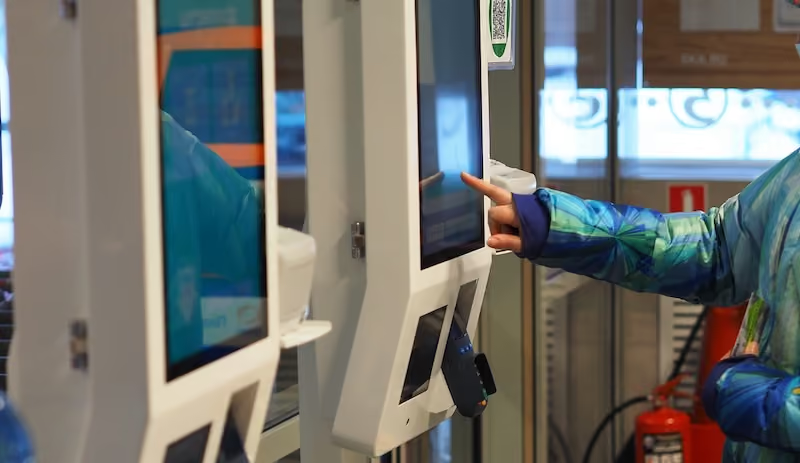
Optimizing payroll costs does not necessarily mean reducing the number of employees. It can mean redeploying them: assigning order-taking and payment processing to self-service kiosks, and focusing staff on customer service, building relationships with customers, and ensuring a smooth flow of service.
Jérôme Varnier, CEO of Innovorder, describes a situation that many retailers have faced: “Take this ice cream chain, for example, which, due to a shortage of staff, was no longer able to open all of its locations. Installing self-service kiosks allowed them to keep their business running. This type of solution makes it possible to optimize service with fewer staff, without having to cut jobs. It’s a response to the labor shortage.”
This model changes the team’s composition rather than reducing its size. Staff freed from order-taking tasks can focus on interactions with higher perceived value, which simultaneously improves both the customer experience and productivity.
3. Tracking productivity using revenue per hour worked
Revenue per hour worked is the most direct indicator for assessing the efficiency of a company’s payroll. Calculated by department, it allows you to compare performance, identify anomalies, and adjust schedules accordingly.
Dalil, co-founder of La Kazdalerie, describes how this management approach changes day-to-day operations: “When it comes to managing my payroll and revenue, with our management tool—since schedules are set up and it’s directly linked to Innovorder—we’re able to say: for this service, I generated this much revenue, I had this many employees working this many hours at this wage: here is my profitability relative to my staff costs. And today, this is a tool we can no longer do without.”
This level of detail transforms management: we shift from a broad monthly overview to weekly—or even daily—decision-making. It is at this frequency that deviations are corrected before they become entrenched.
How can we ensure that service quality remains consistent despite changes?
Any adjustment to the payroll carries the risk of a perceived decline in service quality. The way to manage this risk is to actively measure metrics that reflect the customer experience and monitor them in the weeks following any change to the schedule or team composition.
Four metrics deserve special attention: the NPS (Net Promoter Score) or satisfaction score collected at checkout, the volume of complaints and claims, the number of covers served per shift (a slowdown in pace is quickly apparent here), and the average check (a decline may indicate that service quality has deteriorated). These four indicators, tracked on a weekly basis, provide a reliable picture of the actual impact of adjustments.
Jonathan Jablonski, co-founder of Italian Queen and president of the Leaders Club, sets the tone: “It’s no longer enough to just be a restaurateur; we have to be true managers. We need to manage our restaurants on a weekly basis and produce monthly income statements.”
A properly executed adjustment does not cause these indicators to drop. If they do, it’s a sign that the reduction was made in the wrong place and needs to be corrected before proceeding further.
How can you be sure to reduce costs without compromising service quality? Innovorder’s experts will work with you to analyze your workflows and implement practical solutions tailored to your organization.
"With 20 years' experience working for some of the world's largest foodservice groups, I'm helping the sector with its digital transformation through innovative digital solutions."
"With solid experience in developing key accounts, I'm supporting the digital transformation of the foodservice sector by proposing innovative digital solutions to optimize operations."