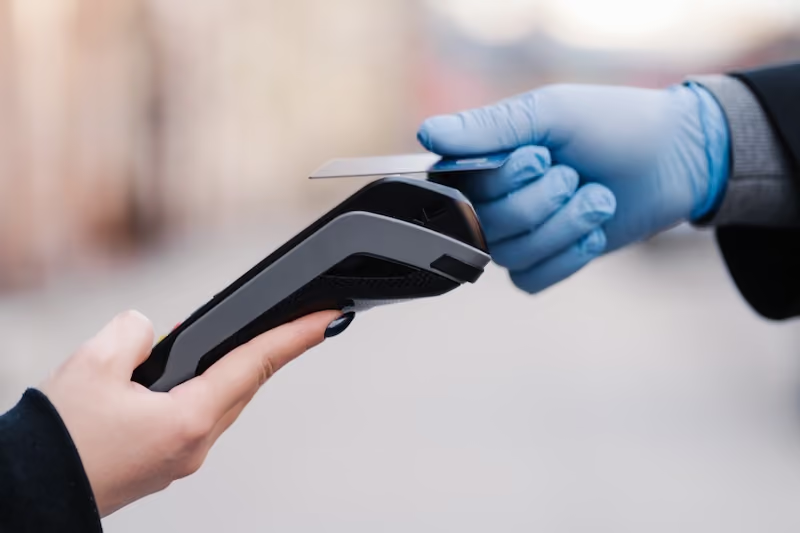
Fraud involving POS terminals: How to secure your payments
Noémie Daniel
Updated on:
03 April 2026
Share this article
Many restaurants and food retailers face attempts at fraud on their electronic payment terminals (EPTs) every day—perhaps you’ve already had the unpleasant experience of this? From card hacking and cloned payment terminals to refund scams, fraudsters are becoming increasingly ingenious, and with the rise of contactless payments and connected terminals, your revenue is now more vulnerable than ever.
But this is by no means inevitable: you can certainly secure your payments, protect your equipment, and, above all, maintain your customers’ trust by following the simple and effective measures outlined in this article.
How do fraudsters target your restaurant?
Piracy of physical terminals: cloned POS terminals and fraudulent connections
Physical hacking remains one of the most common risks. All some fraudsters need to do is connect additional equipment to your POS terminal to clone cards or capture data. Others may install “clone” terminals at high-traffic payment points, such as a restaurant counter or a food truck at an event.
Software fraud and network spoofing: Wi-Fi and vulnerable connections
With the rise of connected small businesses, the risk of software fraud is increasing. Hackers can, for example, intercept your information if you use public Wi-Fi, install malicious software (malware), or set up fake servers to redirect your transactions.
Human manipulation: fake technicians and scams
Even if your POS system and network are well secured, the human factor remains a major vulnerability. Malicious individuals can take advantage of even a small lapse in attention: a fake technician posing as a service provider, a fraudulent reimbursement request, or even an inattentive employee can be enough to compromise your revenue.
Fraudulent refunds: a scam that’s hard to detect
This type of fraud is among the hardest to detect in the restaurant industry. The scheme is well-established: the fraudster makes a purchase with a stolen card—sometimes using the PIN—and then returns within the 14-day return window to request a refund. The fraudster then demands that the refund be issued to a different card than the one used for the purchase, thereby recovering funds that are, in fact, legitimate.
The rule that must be followed without exception: never issue a refund to a payment method other than the one used for the purchase. If the original card is reported lost or stolen, the refund must be issued via bank transfer upon presentation of proof of identity.
What are the consequences of POS fraud for a restaurant owner?
Financial losses and impact on the restaurant
Every instance of fraud represents a net loss for your business. In addition to the amount stolen, you often have to factor in bank fees associated with disputes or refunds, as well as the time spent handling the incident—time that, too, comes at a cost. Ultimately, these situations strain your cash flow and divert your teams from their core business activities.
Damage to reputation and customer trust
Customers need to feel secure when paying the bill, confident that their banking information is protected and that the payment process is handled securely. A confirmed case of fraud can discourage them from returning and tarnish your reputation on social media. The consequences are therefore twofold:
- Loss of loyal customers and difficulty attracting new ones,
- Poor reputation online and on review sites.
Legal sanctions
By failing to comply with PCI DSS standards (security standards for card payments) or the GDPR (General Data Protection Regulation), a restaurant exposes itself to several types of penalties:
- Financial penalties: Failure to comply with the GDPR can result in fines of up to €20 million or 4% of the company’s global annual revenue, whichever is higher. Under PCI DSS, banks or payment providers may impose financial penalties, increase transaction fees, or even temporarily suspend payment services.
- Damage to reputation: A data breach or theft of customer data can quickly make headlines, which undermines customer trust and often leads to a drop in foot traffic and negative online reviews.
- Compliance requirements: In the event of a violation, you will be required to implement corrective measures under supervision, which involves time, costs, and sometimes internal reorganization.
How can you protect your point-of-sale payments in the restaurant industry?
Protecting your VSE: hardware, network and updates
In your restaurant, your payment terminal is just as important as your oven or cash register. To avoid any unpleasant surprises, make it a habit to check your equipment and connections regularly.
Be sure to choose a PCI DSS-certified payment terminal, which is a guarantee of reliability, and avoid used terminals that are not certified. Also, remember to check the connections and security seals, especially if multiple people handle the terminal throughout the day.
When it comes to connectivity, always use a private network or a dedicated 4G SIM card for your payments. Finally, don’t forget to update your firmware and passwords. By following these simple steps, you’ll enhance the security of your payment processing.
Two additional practices can make an immediate difference. Place a distinctive sticker on your terminal (a logo, initial, or color code specific to your establishment): any unauthorized replacement will be immediately obvious. Also, check your remote collection slip every evening: the merchant name and bank code must match your contract details exactly. Any discrepancies must be reported to your service provider immediately.
Detecting fraud early: What warning signs should you watch for?
Vigilance can't be improvised; it requires planning. Just a few seconds of observation before each service can be enough to spot any tampering. Here are the main signs to watch for:
- A case or keyboard cover that is loose, warped, or not securely attached
- A device that looks different from usual (color, logo, serial number)
- An additional cable or device connected to a port on the terminal
- Unusual error messages or inconsistent balance displays
- A terminal that has been moved from its usual location or left unattended
If you have any doubts, do not use the terminal. Isolate it, note the time and circumstances, and contact your service provider immediately. Do not attempt to open it: all physical evidence must be preserved.
Training teams in payment security
When a customer makes a payment, your employees are on the front lines: their vigilance is therefore crucial. Take the time to train them so they can spot suspicious behavior or identify a fake technician.
Also explain to them how to use the POS terminal properly and what to do if a problem arises. A well-informed team reacts more quickly and significantly reduces risks. Once these best practices are incorporated into the department’s routine, they become effective safeguards against fraud.
Choose a connected and supervised VSE
If you want to minimize risks as much as possible, opt for a connected and monitored payment terminal. Why? This type of device allows you to monitor your transactions remotely, receive automatic security updates, and be alerted immediately in the event of an anomaly.
This way, you stay in control of your payments even when you’re not on-site, giving you peace of mind while offering your customers a seamless and secure payment experience.
What should you do if you discover fraud on your POS terminal?
Acting quickly is crucial. Every hour lost after fraud is discovered can increase losses or complicate the recovery process. Here is the four-step procedure to follow:
1. Isolate the device. Take it out of service immediately. Do not open it or handle it further: every physical trace is potential evidence.
2. Contact your payment provider and your bank. Report the incident, specifying the date, time, and nature of the suspected fraud. Your payment provider can block pending transactions and initiate a dispute process.
3. Gather evidence. Receipts, transaction records, and surveillance footage from the relevant time period: these items are essential for any legal proceedings or claims filed with your professional liability insurance provider.
4. File a police report. Go to a police station or gendarmerie with all the documents you have gathered. Filing a police report is a prerequisite for activating your insurance coverage and initiating any bank reimbursement process.
Why choose the Innovorder payment terminal to secure your payments?
Payment security starts with choosing the right service provider. Innovorder obtained NF525 certification as early as 2016, even before it became a regulatory requirement. This certification guarantees tamper-proof and traceable transactions—a non-negotiable requirement for franchise networks and multi-location retailers.
As Olivier Loverde, co-founder of Innovorder, points out:
“We wanted to build a system that offers robust security and fully complies with regulations. This certification builds trust with our customers: transactions are secure and tamper-proof. For a franchise manager or a key account, the absence of fraud is paramount.”
This commitment takes on particular significance at a time when 60% of publishers who applied for certification in 2025 were found to be in major non-compliance (source: ACEDISE, 2025), rendering their previous certifications invalid. The IO Pay payment solution aligns with this approach: secure transactions, a transparent payment processing agreement, remote monitoring, and responsive support.
POS fraud is not an abstract threat: it affects businesses of all sizes, often through simple and preventable means. Daily terminal checks, training staff to recognize warning signs, emergency procedures known to all, and choosing a certified service provider: every measure counts. By combining operational rigor with the right payment solution, you can turn your terminal into a strength rather than a vulnerability.
Want to secure your payments without complicating your daily routine? Our experts will show you how the Innovorder POS terminal meets your on-site needs.
FAQ: POS Fraud in the Restaurant Industry
How can I tell if my POS terminal has been hacked?
There are several warning signs to watch for: a loose or warped casing, a serial number that differs from the usual one, an unknown cable or device connected to the terminal, or unusual transactions on your statements. If you have any doubts, isolate the terminal and contact your service provider immediately without attempting to tamper with it.
What should you do if a customer requests a refund to a card other than the one used for the purchase?
Always decline. Refunds must always be issued to the same payment method used for the purchase. If the original card has been lost or stolen, direct the customer to request a refund via bank transfer, provided they present valid identification.
Is my restaurant liable in the event of fraud involving my POS terminal?
Liability depends on the circumstances. If the terminal is PCI DSS-certified, properly maintained, and you have followed security procedures, liability generally falls on your service provider or the card issuer. However, a failure to comply with security standards may result in your liability and preclude any compensation.
Should you file a complaint even for a minor case of fraud?
Yes, without exception. Filing a complaint is a prerequisite for activating your professional insurance and for any bank reimbursement process.
How often should you check your POS terminal?
A quick visual inspection should be part of the daily startup routine: the terminal’s overall condition, connections, and the remote collection ticket. For high-volume or multi-terminal locations, a mid-shift check is recommended. A thorough inspection (serial number, seals) can be conducted weekly.
"With 20 years' experience working for some of the world's largest foodservice groups, I'm helping the sector with its digital transformation through innovative digital solutions."
"With solid experience in developing key accounts, I'm supporting the digital transformation of the foodservice sector by proposing innovative digital solutions to optimize operations."