Food service: how artificial intelligence improves your profitability
Noémie Daniel
February 3, 2026
Share this article
When we talk about artificial intelligence in restaurants, some people still imagine robots in the kitchen or scenarios straight out of science fiction. In reality, AI is already much more discreet and, above all, much more useful.
Today, it helps you, as a restaurant owner, to regain control of your costs, limit waste, and manage your business with greater visibility. Far from futuristic promises, AI is becoming a very concrete, accessible tool for profitability, perfectly suited to the realities on the ground.
The impact of artificial intelligence on your costs and management
Now let's see how AI can be integrated into your daily life as a restaurant owner to help you better control your costs and manage your business with greater peace of mind.
Anticipate needs to better manage your inventory
One of the main drivers of profitability in the restaurant industry is inventory management. Ordering too much ties up cash flow; ordering too little means losing sales.
Thanks to AI, you can automatically adjust your orders based on past sales, days of the week, and local events. For example, if your restaurant regularly serves more customers on Friday evenings, orders for raw materials are anticipated without manual intervention. The result: fewer shortages, less overstocking, and better cash flow management.
Producing only what is needed to reduce waste
Food waste silently eats away at your margins, but AI can help you anticipate it. By forecasting the quantities actually needed and identifying the products that need to be sold first, before the end of service, it allows youto adjust production to the exact amount required.
In practical terms, this means highlighting certain dishes or adjusting the quantities prepared. You throw away less food and make better use of every product you buy, all without disrupting the running of your kitchen.
Adapting human resources to actual activity
In the restaurant industry, staff often represent the largest expense. AI allows you to better control these costs by planning your teams based on actual activity. How? By using historical attendance data and seasonal trends.
In practical terms, this translates into more balanced schedules: fewer unnecessary hours during quiet shifts, greater fluidity during peak periods, and calmer teams, while keeping your costs under control.
Track your margins and guide your decisions
Not all dishes generate the same margin, and some service hours are more profitable than others. AI makes it possible to transform this raw data into simple, actionable indicators.
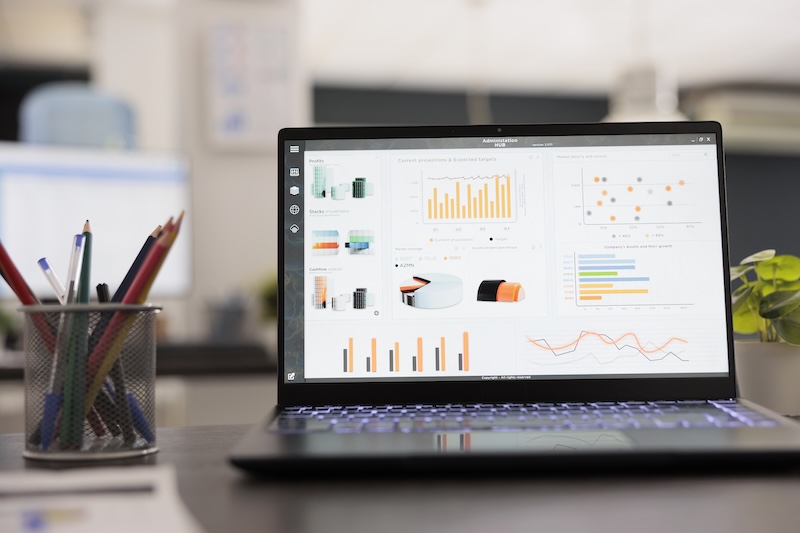
This allows you to adjust your menu, prices, and promotions based on facts rather than intuition. AI-powered dashboards let you see performance by dish, time slot, or period at a glance, so you can make informed decisions without wasting time crunching numbers.
Adopting AI in the restaurant industry: accessibility, deployment, and support
AI has long been perceived as complex or costly. Today, it is accessible and designed to adapt to real-world constraints.
Technology accessible to freelancers and small businesses
Contrary to popular belief, AI is not just for large chains. Many solutions are integrated into smart cash registers and operate on a subscription basis, without requiring heavy investment or advanced technical skills.
Independent restaurants can therefore benefit just as much as large establishments.
The integration of AI in restaurants
Adopting artificial intelligence in the restaurant industry does not require a complete overhaul of your tools or any special technical expertise. The challenge is not to move quickly, but to proceed methodically, with clear and reassuring steps.
Step 1: Identify operational priorities
Start with the most sensitive areas of your business: inventory management, scheduling, or performance tracking. These are often where the first gains appear, without your teams having to put in a lot of effort.
Step 2: Rely on simple and easy-to-read indicators
AI is only useful if it remains understandable. Opt for clear and concise dashboards that highlight discrepancies, trends, and areas of concern without overwhelming the user with information.
Step 3: Test, adjust, then generalize
Recommendations generated by AI enable youto act quickly: adjust an order, review a schedule, or promote a product. Observe the results, refine your approach, and then gradually expand its use.
Step 4: Get teams on board smoothly
AI should be seen as a support, not a control. It is there to help your teams, not replace them. With the right support and a gradual introduction, everyone will quickly understand the concrete benefits in their daily work: less stress on the job, fewer errors, and greater visibility.
When used correctly, artificial intelligence becomes your true ally, promoting profitability and sustainable performance.
Step 5: Implement a continuous improvement approach
Once in place, AI becomes an everyday tool. It supports decision-making on a daily basis without weighing down the organization, and contributes to more stable and sustainable performance.
Atlas, the AI co-pilot for restaurant owners
With Atlas, Innovorder putsartificial intelligence to work in your daily life. This platform transforms your data into concrete actions: anomaly detection, opportunities to seize, recommendations to improve your margins and processes.
Designed for the field, Atlas is ultra-fast and accessible on smartphones or computers, allowing you to manage your inventory, schedules, and sales in real time, without complexity.
Thanks to simple, actionable dashboards, managers and leaders can make better decisions, compare performance, and optimize their actions, while supporting their teams on a daily basis.
Choosing the right AI solution for your restaurant
There's no point in equipping yourself with the most sophisticated tool. Instead, choose one that truly integrates into your daily routine, saving you time while supporting your teams in the field.
“Digitizing your business is a must these days. If you don't have concrete data for your business, it's impossible to monitor and make the necessary adjustments to run your business effectively.”Matthieu and Baptiste, founders of Becchi
Here are the essential criteria to prioritize:
A solution connected to your cash register
The value of AI depends on the quality of the data analyzed. A solution directly connected to your cash register guarantees reliable, up-to-date, and actionable information in real time, without re-entry or manual manipulation.
Easy to use for teams
If the tool is complex, it will not be used. A good AI solution must be intuitive, accessible on both smartphones and computers, and understandable to both managers and department heads.
Data transformed into concrete actions
Seeing numbers isn't enough. AI should help you understand what to adjust: an order to review, a dish to highlight, a schedule to balance. It's this ability to move from data to action that makes all the difference.
Professional support, not just technical assistance
Finally, choose a solution provided by a company that truly understands the constraints of the restaurant industry. Professional support that can guide you, answer your questions, and help you adapt to changing practices is essential for long-term adoption.
Artificial intelligence is not a sudden revolution to be endured, but a tool to be mastered. By starting with simple applications, such as inventory management, performance monitoring, and schedule optimization, you can already generate tangible gains and sustainably improve your profitability without complicating your organization.
-
Would you like to discover how AI can boost your restaurant's profitability in practical terms? Our Innovorder experts are on hand to guide you and show you how to get the most out of your data, simply and effectively.
"With 20 years' experience working for some of the world's largest foodservice groups, I'm helping the sector with its digital transformation through innovative digital solutions."
"With solid experience in developing key accounts, I'm supporting the digital transformation of the foodservice sector by proposing innovative digital solutions to optimize operations."