Cash Register X and Z Reports: Definition, Requirements, and Management
Noémie Daniel
Updated on:
17 March 2026
Share this article
In a restaurant, the cash register isn’t just about processing payments: it must track, monitor, and close out every sale. This is where two essential documents come into play: the X-report and the Z-report. Although these reports are indispensable for both your day-to-day management and tax compliance, they remain unclear to many restaurant owners. What are they really for? When should they be generated? Find out right now.
What are the X and Z codes at checkout?
Reports X and Z are documents generated by your point-of-sale software.
The X-Report: An Interim Statement of Your Business Operations
Report X is a temporary summary of your business activity. It can be generated at any time of day without affecting the cash register data.
Specifically, it allows you to check in real time:
Revenue generated,
The number of tickets issued,
The breakdown of payment methods (credit cards, cash, meal vouchers, etc.),
Best-selling products.
If you've ever felt like you were "flying by the seat of your pants" during a busy period, Report X can help you keep a close eye on your business in real time.
The Z-report: the mandatory daily fiscal closing
The Z-report, also known as the cash register closing report, is much more important from a tax perspective. It marks the official closing of your cash register shift. Once printed, the sales counters are reset to zero for the next day.
There you will find information such as:
Total revenue for the day,
Sales breakdown by category,
Amounts by payment method,
The number of tickets issued,
Cancellations and refunds.
This report can be generated only once a day and serves as accounting and tax documentation of your business activity. In the restaurant industry, it is typically generated at the end of the day, during the cash-out process.
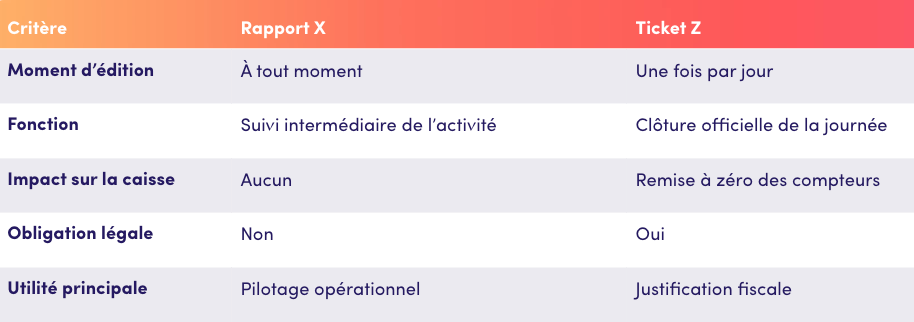
Difference between X and Z: Comparison Chart
To help you avoid confusing X and Z, here’s a simple chart that sums it all up:
In short: the X key lets you review your sales throughout the day, and the Z key lets you close out your cash register at the end of the day.
In France, issuing Z-reports is not just a matter of good internal management. It also fulfills a regulatory requirement designed to combat VAT fraud.
The Legal Framework: the 2018 VAT Anti-Fraud Act
Since January 1, 2018, the anti-VAT fraud law has required merchants using point-of-sale software to ensure the traceability and reliability of recorded transactions.
The goal is to prevent any fraudulent alteration or deletion of sales records after they have been recorded.
In this context, the POS receipt plays a key role: it serves as official confirmation that the day’s sales have been closed and provides an accounting record of the transactions made. Restaurant owners must therefore use POS software that complies with these regulations to generate and retain these reports.
The 4 compliance criteria for point-of-sale software
To comply with the law, point-of-sale software must meet four main requirements.
1. Data integrity:Recorded transactions must not be able to be modified or deleted without a trace.
2. Security: Data must be protected against any fraudulent manipulation.
3. Retention: Sales-related information must be retained for several years.
4. Archiving: Data must be able to be securely archived and accessed in the event of a tax audit.
Penalties for non-compliance: fines of up to €7,500
In the event of a tax audit, the tax authorities may verify that your point-of-sale software complies with regulations and that closing reports are available.
If your system does not comply with regulations or if data is not properly retained, the penalties can be significant:
A fine of €7,500 per non-compliant software program,
How do you manage your cash register X and Z reports on a daily basis?
In a restaurant, managing the cash register should be simple and quick, and a few best practices are all it takes to make it even more efficient.
How often should you run your X and Z reports?
Report X can be used freely to suit your needs. Many restaurant owners use it, for example:
After the lunch service,
Before switching teams,
To monitor activity during a busy shift.
The Z-report, on the other hand, must be printed once a day, usually when the restaurant closes. Does your restaurant stay open late into the night? Some cash registers allow you to adjust the fiscal day.
Cash-out Procedure in the Food Service Industry
In most establishments, the cash register is closed by the manager, the department head, or the store manager.
The procedure is generally as follows:
Check today's cash receipts,
Count the cash in the cash drawer,
Compare with the amount shown by the cash register,
Correct any discrepancies,
Edit Ticket Z.
This routine usually takes a few minutes, but it is essential for preventing errors and cash discrepancies.
How should cash discrepancies be handled?
Sometimes, the actual cash on hand does not exactly match the amount shown on the cash register. There are several reasons why there might be a cash discrepancy:
An error in the change given,
An unregistered order,
A refund entered incorrectly,
A handling error during service.
If a cash discrepancy arises, identify it quickly, note it during the closing process, and keep a record of it to determine the cause.
Archiving and retention: Where should you store your Z tickets?
Z-reports must be retained and archived so they can be presented during an audit. With modern point-of-sale software, these reports are typically:
Automatically saved in the system,
Available via the management interface,
Exportable for accounting purposes.
The best approach is to centralize this data in your point-of-sale software, rather than relying solely on paper receipts.
Above all, good software should save you time every day. To achieve this, nothing beats solutions that allow you to automate certain tasks, such as sending the Z-report via email or automatically exporting data to your accounting software.
Innovorder: an NF525-certified POS system designed for fast food
NF525-certified cash registers ensure tax compliance. Innovorder goes a step further: designed for restaurants and fast-food establishments, they also offer a wide range of practical features and allow you to:
to automatically generate the X and Z reports,
track your revenue in real time,
To simplify the cash-out process,
To centralize all your sales data.
The goal is clear: to let you focus on your business rather than on administrative tasks.
Beyond Compliance: Drive Your Profitability with Your Point-of-Sale Data
Reports X and Z aren't just for compliance. When used effectively, they also become a powerful management tool.
What can you learn by analyzing your point-of-sale data?
Identify your most profitable products,
Identify peak hours,
Compare the performance of the lunch and dinner services,
Often viewed as a mere end-of-shift task, X and Z reports are actually valuable management tools. The X report allows you to monitor your business in real time throughout the day, while the Z ticket formally closes out sales and serves as the basis for accounting.
Together, they give you a clear picture of your business: revenue, payment methods, average check, and performance by time slot. These are all useful metrics for better understanding your restaurant and managing it effectively on a day-to-day basis.
-
Would you like to streamline your daily closing procedures and make better use of your sales data? Innovorder’s experts can help you choose a point-of-sale solution tailored to your restaurant and your business.
"With 20 years' experience working for some of the world's largest foodservice groups, I'm helping the sector with its digital transformation through innovative digital solutions."
"With solid experience in developing key accounts, I'm supporting the digital transformation of the foodservice sector by proposing innovative digital solutions to optimize operations."