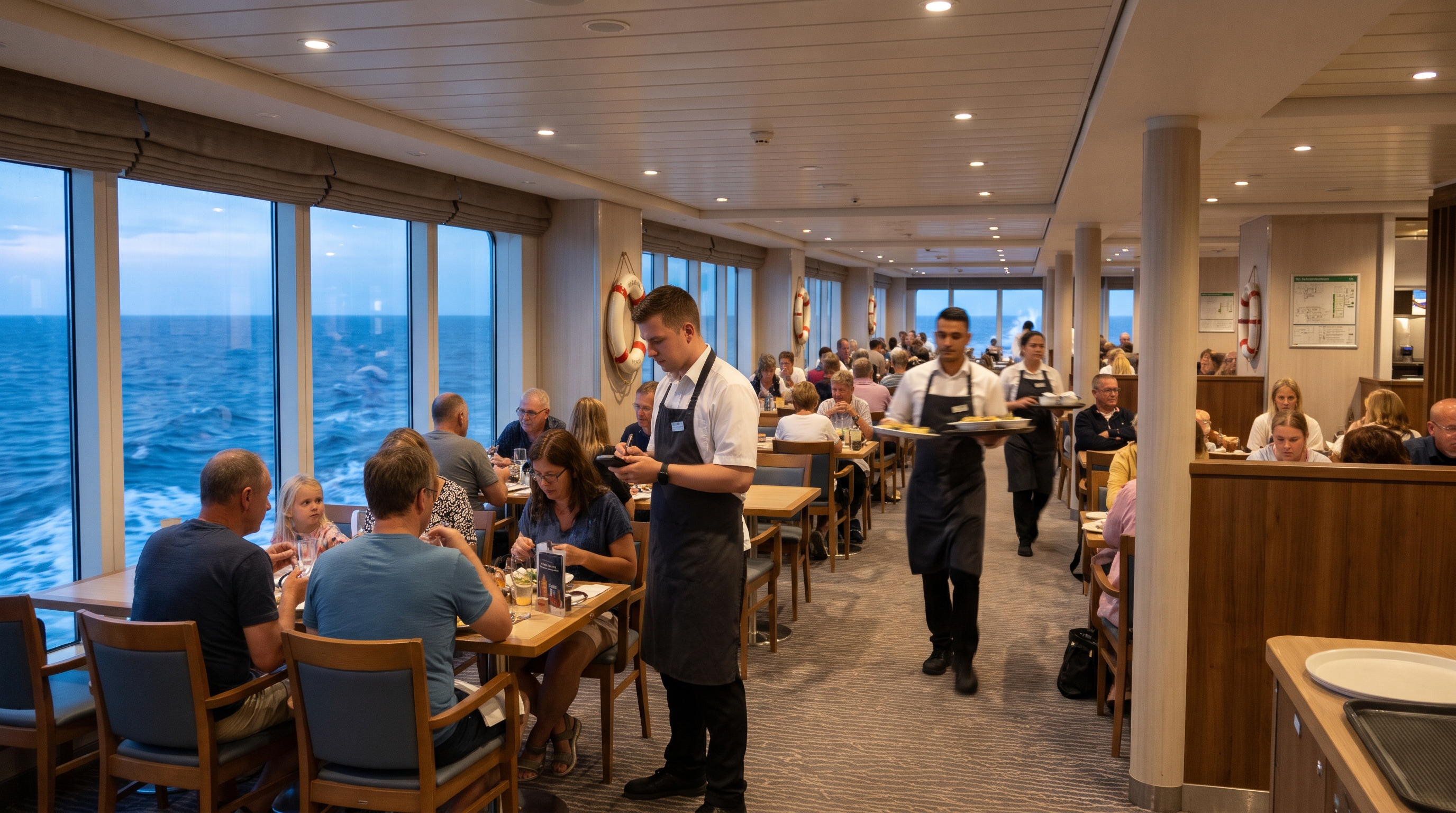
A ferry carrying 2,000 passengers takes a small town on board: a self-service restaurant, an à la carte restaurant, bars on several decks, a café, a shop, sometimes a spa. For the company, onboard dining is a real profit center and a key moment in the passenger experience. But it is managed under conditions that no restaurant on land knows: tax rules change en route, the connection drops offshore, each crossing is closed out like a day in its own right, and no one can come and repair a POS terminal once the ship has left.
What are the challenges of onboard dining, what constraints do they create, and how can they be addressed in practice? We had to answer all these questions when equipping the Corsica Ferries fleet, starting with the Mega Serena, in service since 4 November 2026. Here are those challenges one by one, and how we addressed them on board.
Key takeaways : Ferry onboard dining must reconcile four challenges: tax compliance across several countries, service continuity at sea, management by crossing, and control of rotating crews. This requires a POS system that automatically applies the VAT of the navigation zone, works offline thanks to an onboard server, links each sale to its trip, and can be managed from shore. Deployment matters as much as the software: onshore lab testing, equipment stored on board, support during the first crossings, and remote support. Innovorder implemented the whole solution on a ferry carrying 2,000 passengers, and is replicating it ship after ship.
Onboard dining: an economic challenge concentrated into a few hours
In Europe, 69 ports each welcome more than one million ferry passengers per year, according to Le Marin. In Corsica, in July and August, more travelers arrive on the island by ferry than by plane, according to the DREAL Corse transport report. Each crossing is a sales opportunity: breakfast before arrival, dinner after the evening boarding, drinks, shop.
But these sales happen in very short windows. Data from the Mega Serena, reported in Atlas, Innovorder's data platform, clearly show this over three weeks of operation:
- Between 7 p.m. and 8 p.m., just after evening boarding, the ship generates 26% of its revenue. From 6 p.m. to 9 p.m., it is half.
- Between 6 a.m. and 9 a.m., before arrival in port, more than a quarter of transactions take place, for 14% of revenue: breakfasts served in series, where speed matters more than basket size.
- The outlets have nothing in common. The à la carte restaurant generates around 30% of revenue with less than 10% of orders, while the café and lounge account for nearly two-thirds of orders, with baskets of a few euros.
The first challenge is therefore simple: lose nothing during peak times. A slow POS system, a line that is too long at the deck bar, or an outlet blocked at 7 p.m. means a significant share of the crossing's revenue is lost.
Our reference: the Mega Serena from Corsica Ferries
This ferry connects Toulon, Bastia and Livorno and can accommodate up to 2,000 passengers. Its 13 outlets (self-service restaurant, à la carte restaurant, bars, café, lounge, shop and spa) operate with 20 POS terminals and 4 Innovorder ordering pads. Put into service on 4 November 2026, it has been operated autonomously by its crew since the end of the first accompanied crossings. Nine other ships in the company's fleet will follow, representing nearly 90 outlets across the entire fleet.
Challenge no. 1: staying compliant when the ship changes countries
On the same route, a ferry can leave from a continental port, call in Corsica and arrive in Italy. Depending on the navigation zone, the applicable VAT is not the same, nor are the mandatory statements on the receipt, and some countries impose their own tax system. Added to this are rules specific to each product or service: a spa treatment does not follow the same logic as a meal, and an alcohol sale may require a specific declaration. For the company's finance department, the challenge is twofold: be compliant in each country, and be able to prove it in the event of an audit.
In practice, during the deployment of Corsica Ferries' first ferry, the Mega Serena, all combinations of departure zone and navigation zone for the company's routes were configured in the POS system: fourteen in total. The POS system automatically applies French, Corsican or Italian VAT depending on the zone crossed, and the crew has nothing to choose. Each receipt carries the statements required by the relevant administration, including the “not taxable” statement when required rather than a simple 0% rate, as well as the country's tax identifiers. The tax rules at the time of sale are kept on the receipt, even when the sale was made offline.
For sales subject to Italian regulations, the POS system is connected to the fiscal server required in Italy, integrated with our partner Fiskaltrust. This server had to be installed in an Italian port: the operation was scheduled during a stopover in Livorno of just over an hour. Before going live, the entire setup was validated receipt by receipt with the finance department of the company.
The result can be seen in the data: over three weeks, six different VAT rates were applied on board, and more than half of the menu items were sold at at least two rates. The same espresso is not charged the same way depending on the zone the ship is in.
Challenge no. 2: keep selling when the connection drops
At sea, internet goes via satellite and depends on weather and coverage. At the dock, the ship switches to the mobile network. In between, outages are frequent. However, many POS or digital ordering solutions require a stable connection to take an order or validate a payment. Offshore, that is not an option. The risk is not only blocking sales: it is also, when the connection returns, attaching sales to the wrong trip or the wrong tax treatment, with discrepancies that are impossible to reconcile later in accounting.
On the Mega Serena, a server installed on board runs the ship's 13 outlets, POS terminals and ordering pads, on a local network. Sales continue regardless of the state of the satellite link, then automatically synchronize with the cloud as soon as the connection returns, without any action by the crew. Every action performed offline is checked during synchronization: if the trip has changed in the meantime, nothing is attached at random. All POS terminals are set to the ship's time, onboard data is backed up every day, and updates take place at night, when the outlets are closed.
From the first morning of operation, the satellite link proved unstable: reconnection management was strengthened in the following days, without interrupting onboard sales.
Challenge no. 3: manage by crossing, not by day
On land, a restaurant opens in the morning and closes in the evening. On board, the unit of management is the crossing : a departure, an arrival, sometimes a stopover. The onboard purser must be able to say how much each outlet sold on each trip. Departures are often delayed, some journeys are made in two legs with a stopover, and a ship can run several crossings in the same day. For Corsica Ferries, this was the “blocking point for onboard teams” from the start of the project.
On the Mega Serena, each sale carries its trip : route, departure date, ship and trip reference, retrieved from the company's booking system. Sales can be viewed and exported by crossing and by outlet in the back office, and reconciled with the company's data thanks to this reference. Opening and closing are centralized on a dedicated station, the Onboard Assistant: the purser opens the crossing and closes all the ship's outlets in one action, without going from POS terminal to POS terminal.
Special cases were handled one by one: an offline POS terminal does not block the closing of the others, and on a journey with a stopover, an order still open is settled on the first trip and then carried over to the next, with the correct tax treatment. When a delayed departure in Livorno revealed a case that testing had not covered, a workaround was immediately given to the crew and the fix delivered in 25 minutes. Onboard teams also wanted to manage departure delays themselves: their requests were included in subsequent versions.
👉 To go further: X and Z reports: definition, obligation and management
Challenge no. 4: serve quickly outlets that are nothing alike
A café churning out breakfasts, a self-service restaurant with continuous flow, an à la carte restaurant with table service and kitchen production, a deck bar, a shop selling takeaway, a spa: on the same ship, each outlet has its own uses, peaks and payment methods. And everything must work with the same menu, the same tax rules and the same data.
On the Mega Serena, the 13 outlets are connected in a single system. POS terminals fixed at the counter keep up with throughput, mobile POS terminals go closer to passengers when the line grows, and the teams adopted them very quickly. In the à la carte restaurant, [ordering pads](https://www.innovorder.com/pad-de-commande) connected to the POS terminals take orders at the table and send them directly to the kitchen, to production printers by station (hot, cold, drinks, desserts), with tickets in the kitchen brigade's language. The menu is centralized, in French and Italian versions, with distinct sections depending on the route's clientele.
All payment methods are accepted: over three weeks, card payments and contactless account for half of the amounts collected, cash for more than a quarter and meal vouchers for one fifth, not counting prepaid meals.
👉 To go further: Ordering pad or fixed POS: how to make the right choice?
Challenge no. 5: connect the POS system to prepaid meals and the company's system
Some passengers buy their meal before boarding, with their ticket or at the dock: it is simpler for them, and often cheaper. On board, these prepaid meals must be recognized instantly, with no possibility of fraud, with precise rules: which products they apply to, what happens if an amount remains, how they are treated for tax purposes. At the same time, the POS system must retrieve the company's trips and catalog, and send its sales back to the company.
On the Mega Serena, prepaid meals take the form of QR coupons, read directly at the POS. A coupon can be used in several instalments: a new QR code is issued for the remaining amount. Each coupon is protected against double use and has its own scope (full meal, drinks, wines). Depending on the route and its tax rules, it is treated as a payment method or as a discount, and the receipt clearly indicates this. The POS system is also connected via API to the company's information system, to retrieve trips and the catalog (items, set menus, menus) and send sales back.
These rules were tested by the company in onshore labs, before boarding : that is where a coupon treated as a discount instead of a payment was identified and corrected, before going live.
Challenge no. 6: keep control with rotating crews
A ship's crew is not like a restaurant brigade. Crew members change ships, often work seasonally, do not always have a professional email address and speak several languages. Across an entire fleet, that means around 180 people to train. At the same time, the company must monitor payments, cash and sensitive actions across dozens of POS systems that no manager sees at the same time.
For Corsica Ferries, accounts were created by role (sales assistant, manager, support) rather than by individual name, “given the turnover,” as the company put it. Each user logs in and switches operator with a badge, with no code to remember. Sensitive actions are governed : deleting a line, removing a quantity, reprinting a receipt or coupon, opening the cash drawer outside a transaction, accessing closing figures, with a manager's approval when necessary. On-board-specific rules were added, such as staff meals or discounts requiring a mandatory reason for certain customer groups.
The interface, production tickets and support are available in French and Italian, and training was provided primarily in Italian. Since go-live, the company has requested new settings for permissions and for tracking cash drawer openings by crossing: they are included in the roadmap.
Challenge 7: ensuring continuity when no one can step in
On land, a faulty POS system can be replaced within the day. At sea, no technician comes on board. Space is limited for storing equipment, and the installation itself must be done during the port call, without an IT lead on board. Everything must therefore be planned in advance: equipment, procedures and remote support.
On the Mega Serena, the hardware is identical from one outlet to another, so that each POS system is interchangeable, and it will be across the entire fleet. With space limited, a maximum of two backup POS systems are stored on board, prepared on land (software, language, settings). A procedure allows replacing a POS system mid-crossing : the backup POS system takes the accessories from the faulty one (badge reader, cabling), then is linked to the current crossing. Forced closure of the old POS system requires a justification, to keep a record of every operation.
Support is reachable 7 days a week from on board, via ticket and by phone in the event of a blocking emergency, with an automatic alert to our teams and a follow-up check every morning. Fixes and updates are delivered remotely, without waiting for the return to port, and more than 1,200 automated tests have been added to the POS system to protect each register. A new version was even deployed mid-crossing, and two crew requests raised one evening were in production two and a half hours later.
Challenge 8: rolling out ship by ship without disrupting operations
A ship does not stop for software to be installed. Installation takes place at the dock, in a single day, between two rotations. Everything must be validated beforehand, and the crew must become self-sufficient very quickly.
For the Mega Serena, it took just under four months between the operational launch of the project and go-live, in six stages:
- Weekly workshops with the company's teams : catering, finance, IT.
- Onshore labs, in Bastia, Savone and Paris, that replicate the ship's customer journeys exactly, to test coupons, receipts, legal notices and special cases with the Corsica Ferries teams.
- Equipment delivered and stored on board in advance.
- A one-day installation at the dock, team training, then two and a half days of on-board support before the crew is fully self-sufficient.
- A “control tower” on land during the first crossings: automated checks every hour, summaries several times a day, and a simple rule: no configuration changes during a crossing.
- The switch to 7 days a week support once the crew is self-sufficient.
For subsequent ships, the installation procedure and on-board server configuration are reused, for an identical experience across the entire fleet.
After go-live: a solution that keeps adapting
The first crossings always reveal needs that only real operations bring to light. On the Mega Serena, the company submitted eighteen change requests in the weeks following the launch: offline operation of tablets, permissions, payment tracking, Assistant de bord, order at table. The company prioritizes them in a shared roadmap; we deliver them release after release.
This co-construction is what makes it possible to move from a pilot ship to an entire fleet.
Cruise and tourism boats: the same foundations, different uses
Sea or river cruising, sea excursions: the foundations are the same (offline operation, zone-based taxation, crews, fleet management), with a few differences:
- The stay lasts several days : sales are tracked by day, by port of call and by cruise.
- The passenger has an on-board account : drinks packages, charges linked to the cabin, payment at the end of the stay.
- Ordering takes place everywhere : at the deck bar, by the pool, in the lounge or from the cabin.
- The customer base is international : menus and ordering journeys must follow the passenger's language.
- Tourism boats have short rotations : on an excursion lasting a few hours, everything hinges on a single peak.
The Innovorder range already covers these uses on land, in theme parks, campsites and food courts: Click & Serve for ordering and paying from your seat via QR code, the self-ordering kiosk to absorb peaks, online ordering for pre-ordering, the e-wallet for a prepaid account and thekitchen display system for kitchens. Experience gained at sea adds offline operation, zone-based taxation and trip-based management.
Checklist: digitalizing on-board catering across your fleet
- Map the points of sale on each ship : type of service, number of POS systems, decks, peak-hour flows.
- List the tax zones for each route and the required legal notices, with your finance department.
- Check offline operation : what happens when the connection drops mid-sale, and then when it comes back?
- Choose the management unit : the crossing, the day or the cruise, with its specific cases (delays, port calls, multi-leg journeys).
- Plan the links with your information system : trips, catalogue, ticketing, prepaid meals, passenger accounts.
- Define permissions by role and the actions that require a manager's approval.
- Organize the rollout : onshore labs, a one-day installation at the dock, accompanied crossings, backup POS systems on board.
- Set the support process : who calls whom, through which channel, and how to intervene without a technician on board.
What the software does not solve
The right software lightens the crew's workload, but it does not replace on-board organization: the evening rush is first prepared with the right staff in the right place, and training rotating crews requires continuous effort. As for the tax rules for each route, the POS system applies them but does not define them: they still need to be validated with the company's finance department and its advisors.
Do you operate ferries, cruise ships or tourism boats? Let's talk about your on-board constraints. Talk to an expert
FAQ
The questions shipping companies ask most often about on-board catering.
What are the challenges of catering on board a ferry?
Staying compliant across multiple tax regimes, continuing to sell when the connection drops, managing sales by crossing, serving quickly during very short peaks, linking the POS system to prepaid meals and the company's system, controlling rotating crews and ensuring continuity without a technician on board.
Which software should you choose for catering on board a ferry?
POS software that works offline thanks to an on-board server, applies VAT according to the navigation zone, links each sale to a crossing and covers all the ship's points of sale.
Do you need an offline mode to take payments on a boat?
Yes. At sea, satellite connectivity is never guaranteed. POS systems must take payments on a local network, then synchronize sales without linking them to the wrong trip.
How do you manage multiple tax regimes during a crossing?
The POS system automatically applies the VAT and legal notices of the zone being crossed. The settings for each combination must be validated in advance with the company's finance department.
How do you connect the POS system to the company's ticketing system?
Via API: the POS system retrieves trips and the catalogue from the company's system, and each sale carries its trip reference. Prepaid meals are read at the POS system using a QR coupon.
How do you manage multiple ships and dozens of points of sale from land?
Sales from all ships feed into a shared platform, which can be viewed by ship, by route, by crossing and by point of sale. Updates and support are handled remotely.
What are the differences between ferry catering and cruise ship catering?
A ferry is managed by crossing, with very short peaks at boarding. A cruise lasts several days, with passenger accounts, packages and ordering everywhere on board. In both cases, you need to take payments offline, manage multiple tax regimes and languages, and manage the fleet from land.
Sources